Why this vehicle matters
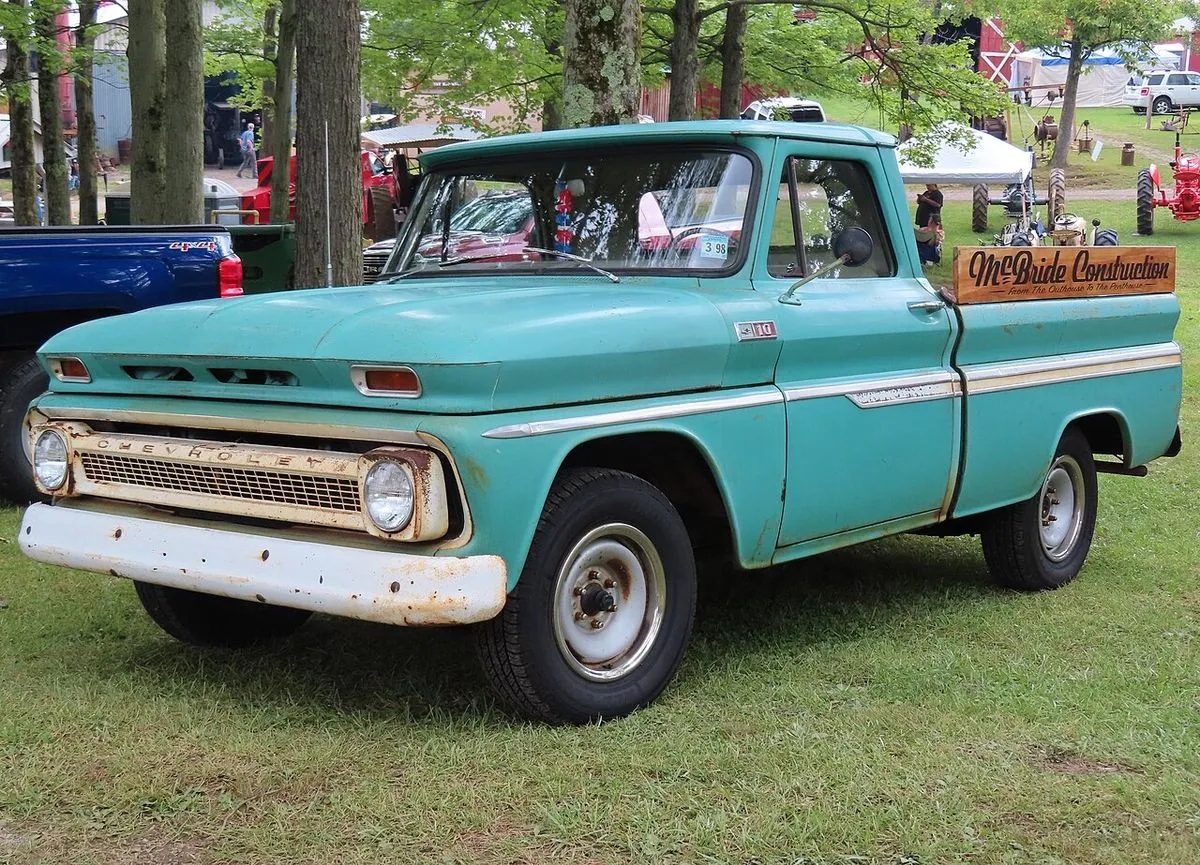
The 1960-66 Chevrolet C10 is the truck that made pickups cool. Before this generation, trucks were strictly utilitarian. GM's designers gave this truck car-like styling — the wraparound windshield, sweeping fender lines, and available Custom Cab interior made it something you'd want to drive, not just need to drive.
The drop-center frame lowered the floor height for easier entry. The optional V8 engines made them quick. These trucks launched the custom truck scene that continues today. A well-built 1966 C10 was the truck every high schooler in America wanted.
Patina notes
These trucks developed the patina aesthetic. Original Apache Green, Cardinal Red, or Omaha Orange with faded paint and surface rust is the look that launched a thousand magazine covers. The chrome is relatively simple and rechromes well.
Watch for rust in the cab corners, floor pans, and bed floor — especially where the bed meets the cab. The inner fenders and firewall also rust from road spray.
The big rear window (1960-63) versus small rear window (1964-66) is a stylistic choice — big window trucks are generally more valuable.
Ownership reality
LMC Truck has everything. Classic Industries has everything else. These trucks share engines and transmissions with millions of Chevrolet cars from the same era, so mechanical parts are everywhere.
The inline-6 engines are bulletproof but slow; the V8 engines make these trucks fun. Common upgrades include power steering, disc brakes, and modern fuel injection — all available as bolt-on kits. The truck community is massive and welcoming. A complete frame-off restoration is achievable in a home garage.
The verdict
Buy if
You want the truck that started the custom truck movement. You appreciate pre-smog era simplicity. You're ready to join one of the largest enthusiast communities in the hobby.
Skip if
You need a truck that's comfortable on long drives in stock form. You want something that stands out from other truck show entries. You're not prepared for body rust repair.
What to look for
- → Cab corners rust (the most common problem)
- → Floor pans under rubber mats
- → Bed floor rust at wheel wells and tailgate
- → Inner fender and firewall rust from road spray
- → Frame rust at body mounts
- → Wraparound windshield pillar rust
- → Bed-to-cab gap alignment
Common problems
- ⚠ Cab corner rust is nearly universal
- ⚠ Floor pan rust under rubber mats
- ⚠ Door hinge pins wear causing sag
- ⚠ Vacuum windshield wipers are slow
- ⚠ Generator charging issues (upgrade to alternator common)
- ⚠ Drum brakes inadequate for modern traffic
Parts & community
Parts sources
- LMC Truck
- Classic Industries
- Brothers Truck Parts
- National Parts Depot (NPD)
- Mar-K Specialties
Forums & communities
- 67-72 Chevy Trucks Forum
- The Stovebolt Forums
- ChevyTalk.com
- GMC Truck Forums
Sources
- Hagerty Valuation Tools · 2026-02-01
- Bring a Trailer auction results · 2026-02-01
Specifications
| Engine | 235 I6 / 261 I6 / 283 V8 / 327 V8 |
| Power | 140-220 hp |
| Torque | 220-355 lb-ft |
| Transmission | 3-speed manual / 4-speed manual / Powerglide auto |
| Drivetrain | RWD |
| Weight | 3,200-3,800 lbs |
| Wheelbase | 115-127 inches |
| Production | 1,800,000+ (all variants) |
Notable Features
- • Drop-center frame for low floor height
- • Wraparound windshield
- • Available Custom Cab and Fleetside bed
- • Last year of this body style was 1966
About Chevy
Ford's eternal rival. The bowtie that launched a thousand hot rods.
View all Chevy vehicles →Find one
Looking to buy? Search current and past listings on Bring a Trailer.
Search on Bring a Trailer →More from Chevy
1967 Chevy Corvette C2 Stingray
1963-1967
1969 Chevy Camaro SS/Z28
1969
1970 Chevy Chevelle SS 454
1970-1972
1970 Chevy El Camino SS 454
1968-1972
1967-1972 Chevy C10
1967-1972
1972 Chevy Monte Carlo
1970-1977
1973 Chevy Camaro Z28
1970-1981
1975 Chevy G20 Van
1971-1995
1976 Chevy Chevette
1976-1987
1973-1987 Chevy C/K Square Body
1973-1987