Why this vehicle matters
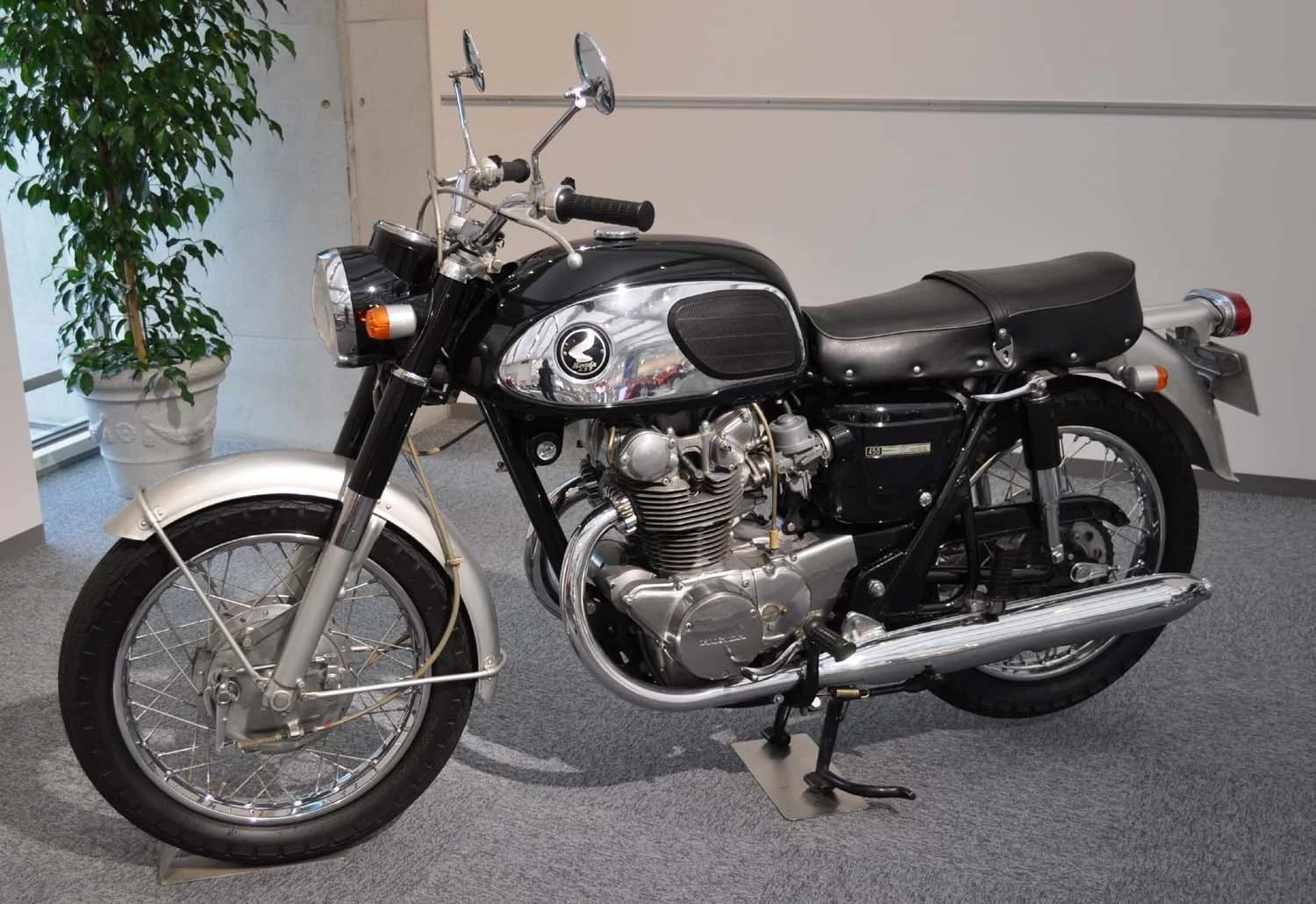
The CB450 was Honda's declaration of war on the British motorcycle industry. Before this, Honda made small bikes — clever, reliable, but small. The 'Black Bomber' was Honda's first big twin, aimed directly at the Triumph Bonneville's throat.
A DOHC engine with torsion bar valve springs at a time when British bikes were still running pushrod singles and twins. It was technically superior to everything from Birmingham and Meriden. The British laughed. Within a decade, they were bankrupt. The CB450 was the first shot; the CB750 was the kill shot.
Patina notes
The original black-and-silver color scheme on the early 'Black Bomber' models (1965-1967) is stunning and rare in good condition. Later K-series bikes came in more colors.
The DOHC head is a visual signature — the cam cover dominates the top of the engine. Chrome on the fenders, exhaust, and tank trim ages predictably. The torsion bar valve springs are internal, so you won't see them, but they're what makes this engine special. Early round-tank models are more valuable than later squared-off versions.
Ownership reality
The CB450 shares Honda's legendary parts infrastructure with the smaller twins, though some CB450-specific parts (particularly torsion bar springs) are getting scarce.
The DOHC engine is more complex than the SOHC engines in the CB350 and CB360 but still straightforward for a competent mechanic. Valve adjustment is different because of the torsion bars — learn the procedure or find someone who knows it.
The bike rides bigger than its displacement suggests. It's not a CB750, but it was never trying to be. It was trying to kill Triumphs, and it succeeded.
The verdict
Buy if
You appreciate the engineering story — Honda's first big twin, the bridge between small bikes and the CB750. You want something rarer and more interesting than a CB350 without paying CB750 money.
Skip if
You want the simplicity of Honda's SOHC twins. You're not comfortable with torsion bar valve spring maintenance. You'd rather have the bike that actually killed the British industry (that's the CB750).
What to look for
- → Torsion bar valve spring condition (specialized knowledge needed)
- → Cam chain tensioner wear (listen for rattle at idle)
- → Crankcases for cracks or repairs (common if dropped)
- → Charging system output (early alternators were marginal)
- → Drum brake effectiveness (front and rear)
- → Oil leaks at cylinder base gaskets
Common problems
- ⚠ Torsion bar valve springs fatigue (unique to CB450, not cheap to replace)
- ⚠ Points ignition timing drift
- ⚠ Charging system inadequacy on early models
- ⚠ Carburetor synchronization issues (CV carbs are finicky when worn)
- ⚠ Cam chain tensioner wear causes timing noise
- ⚠ Regulator/rectifier failures
Parts & community
Parts sources
- Common Motor Collective
- 4into1.com
- David Silver Spares (UK)
- eBay (NOS parts still surface)
- Honda Twins Forum classifieds
Forums & communities
- HondaTwins.net
- SOHC/4 Owners Club (broader Honda community)
- Reddit r/HondaCB
- Vintage Honda Forum
Sources
- Bring a Trailer · 2026-02-28
- Motorcycle Classics · 2026-02-28
Specifications
| Engine | 444cc DOHC air-cooled parallel twin |
| Power | 43 hp @ 8,500 rpm |
| Torque | 28 lb-ft @ 7,250 rpm |
| Transmission | 4-speed (early) / 5-speed (later) |
| Drivetrain | Chain |
| Weight | 412 lbs wet |
| Wheelbase | 54 inches |
| Production | High volume, 1965-1974 |
Notable Features
- • DOHC (double overhead cam) — first on a production twin
- • Torsion bar valve springs (unique engineering solution)
- • 180-degree crankshaft
- • CV carburetors
Find one
Looking to buy? Search current and past listings on Bring a Trailer.
Search on Bring a Trailer →More from Honda
1958 Honda Super Cub
1958-present
1969 Honda CB350
1968-1973
1969 Honda CB750
1969-1978
1974 Honda CL175 Scrambler
1968-1973
1974 Honda CT70 Trail
1969-1994
1975 Honda Gold Wing GL1000
1975-1979
1982 Honda CX500 Turbo
1982-1983
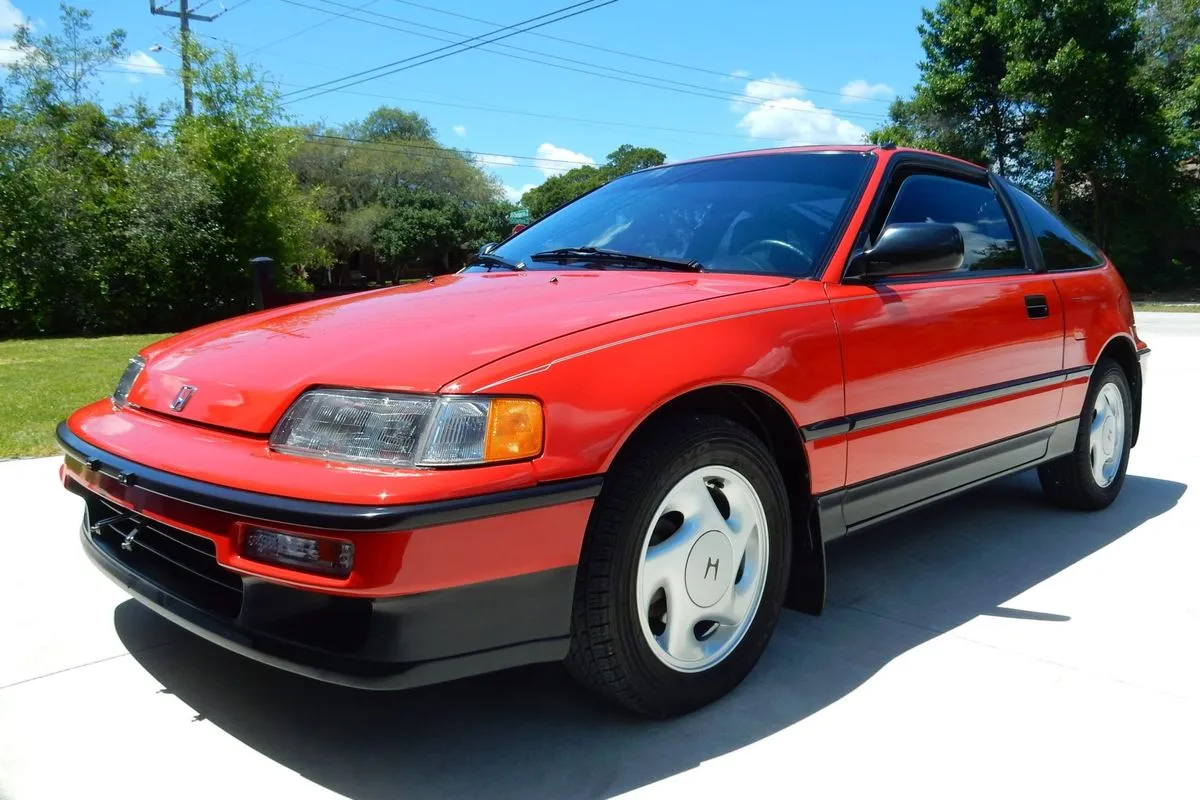
1990 Honda CRX Si
1988-1991