Why this vehicle matters
The Li'l Red Express was Dodge's middle finger to the malaise era. While passenger cars choked on emissions equipment and made embarrassing power numbers, Chrysler noticed that light-duty trucks were exempt from the same regulations.
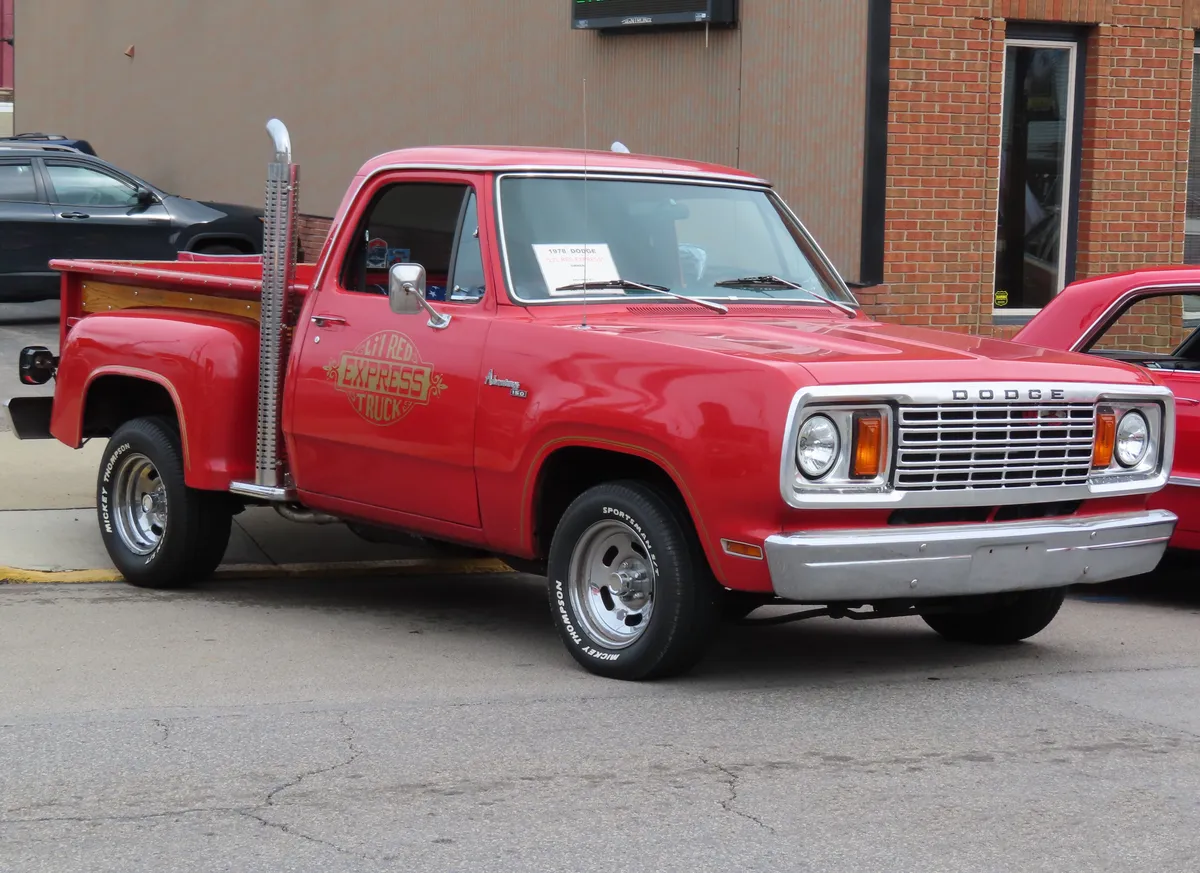
So they dropped a 360 V8 with a performance cam, free-flowing exhaust, and those absurd chrome stacks into a D150 shortbed. The result? The fastest American vehicle you could buy in 1978, capable of 14.7-second quarter miles when Corvettes were struggling to break 16.
It was a factory hot rod disguised as a work truck, painted Bright Canyon Red and wearing its wood rails and gold stripes like a badge of honor.
Patina notes
The Li'l Red Express was a special-edition truck, so most survivors have been preserved or restored. The chrome stacks are the signature element — they should be intact and free of dents.
The wood bed rails crack and split over time; reproduction parts exist. The gold graphics fade and peel; quality decal kits are available. Finding one with original graphics in good shape commands a premium.
Ownership reality
This is a regular D-series truck underneath the costume, which means parts availability is excellent. The 360 V8 is a known quantity — reliable, easy to work on, and well-documented.
The automatic was more common than the 4-speed manual, and manual trucks are worth more. These were limited production, so finding a clean example takes patience, but once you have one, maintenance is straightforward pickup truck stuff.
The verdict
Buy if
You want malaise-era performance with a sense of humor. You appreciate Chrysler's creative workaround. You like trucks that start conversations.
Skip if
You want a serious work truck. You can't stand the attention. You need 4x4 (it wasn't offered).
What to look for
- → Chrome stack condition (dents, rust)
- → Wood bed rail integrity
- → Original graphics (or quality reproductions)
- → Bucket seat condition
- → 360 engine health
- → Frame rust (especially in salt belt trucks)
Common problems
- ⚠ Wood rails crack and deteriorate
- ⚠ Graphics fade and peel
- ⚠ Chrome stacks dent easily
- ⚠ Standard Mopar rust areas
- ⚠ A/C delete common (adds value to have it)
- ⚠ Manual trans trucks are rare
Parts & community
Parts sources
- LMC Truck
- National Parts Depot
- Year One
- Rock Auto
- Mopar restoration specialists
Forums & communities
- MoparTrucks.com
- For A Bodies Only
- Dodge Talk Forum
- Li'l Red Express Registry
Sources
- Hagerty Valuation · 2026-02-04
- Bring a Trailer results · 2026-02-04
Specifications
| Engine | 360 cu in (5.9L) V8 |
| Power | 225 hp @ 3,800 rpm |
| Torque | 295 lb-ft @ 3,200 rpm |
| Transmission | 4-speed manual / 3-speed automatic |
| Drivetrain | RWD |
| Weight | 4,000 lbs |
| Wheelbase | 115 inches |
| Production | Approximately 7,500 (1978), 5,118 (1979) |
Notable Features
- • Chrome exhaust stacks behind cab
- • Gold pinstriping and graphics
- • Wood bed rails
- • Bucket seats
- • Fastest American vehicle 0-100 in 1978
About Dodge
Chrysler's muscle brand. Dodge has always been the division willing to build something a little wilder than the competition.
View all Dodge vehicles →Find one
Looking to buy? Search current and past listings on Bring a Trailer.
Search on Bring a Trailer →