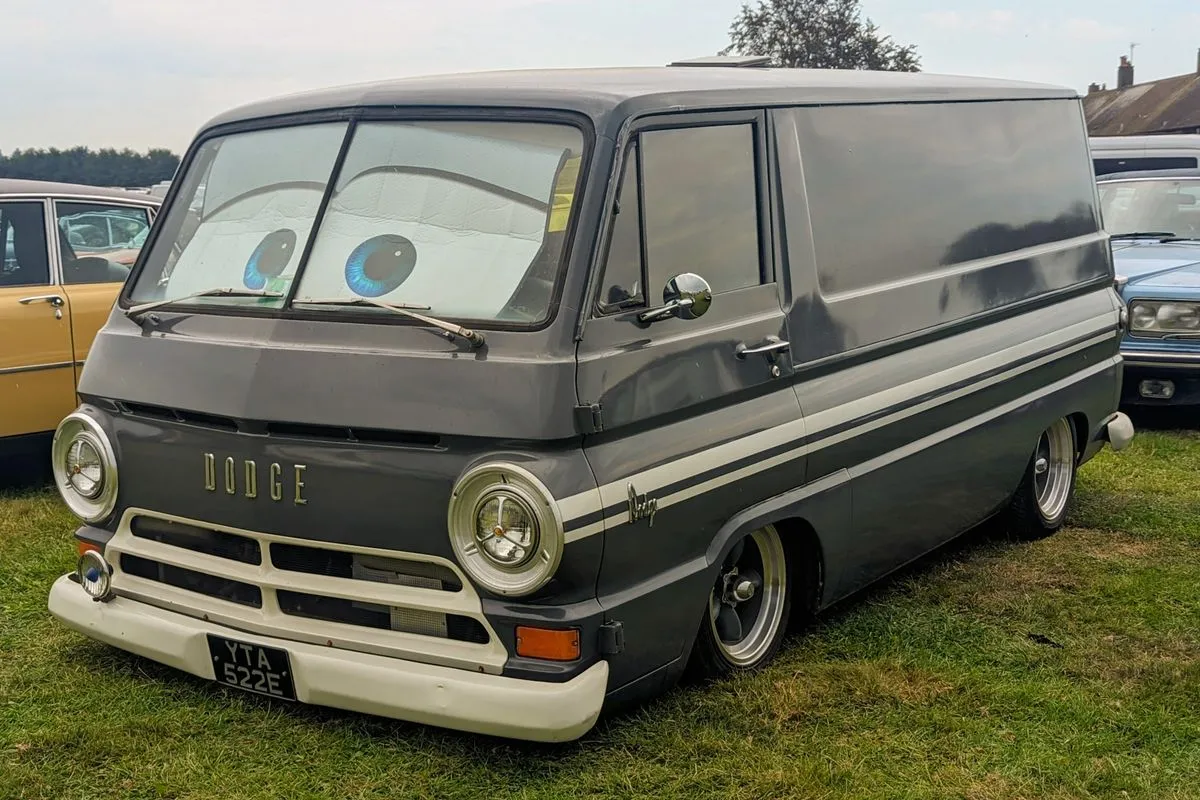
Why this vehicle matters
The A100 is the muscle van. While Ford and GM were putting economical sixes in their compact vans, Dodge offered a 318 V8. The legendary 'Little Red Wagon' drag truck was an A100. This was Chrysler being Chrysler — if some is good, more is better.
The forward-control design put you right over the front wheels, which was either exciting or terrifying depending on your perspective. The A100 proved that vans didn't have to be boring.
Patina notes
A100s were used hard in commercial service. Panel vans carry decades of painted-over signage. Pickups have bed wear from actual hauling. The cab-forward design means the front seats sat over hot drivetrain components, which affected interior condition.
But a well-worn A100, especially a V8 model, has a presence that transcends condition. Let it look like what it is.
Ownership reality
Slant-6 models are bulletproof and parts are everywhere. V8 models are more desirable but share the same basic infrastructure. The cab-forward design makes engine access awkward.
Chrysler parts interchange across their lineup, so sourcing is manageable. The community is smaller than Ford/Chevy but dedicated. Finding a clean example is harder than keeping one running.
The verdict
Buy if
You want a van with actual character. You appreciate Chrysler's 'more power' philosophy. You're ready for cab-over driving dynamics.
Skip if
You need comfortable highway cruising. You require extensive parts availability. You can't embrace the cab-over experience.
What to look for
- → Floor rust (engine heat accelerates)
- → Cargo floor rust
- → Lower body rust
- → Engine condition (Slant-6 vs V8)
- → Transmission condition
- → Brake system condition
Common problems
- ⚠ Floor rust from heat and water intrusion
- ⚠ Carburetor issues
- ⚠ Brake proportioning
- ⚠ Door alignment
- ⚠ Weatherstripping deterioration
- ⚠ Electrical connections corrosion
Parts & community
Parts sources
- Mancini Racing (Mopar specialist)
- Year One (Mopar parts)
- RockAuto (Slant-6 and V8 parts)
- eBay (A100-specific)
- For A Bodies Only (forum classifieds)
Forums & communities
- For A Bodies Only
- Mopar Forum
- AllPar.com
- Facebook A100 groups
Sources
- Hagerty Valuation Tools · 2026-02-02
Specifications
| Engine | 170ci Slant-6 / 225ci Slant-6 / 318ci V8 |
| Power | 101-230 hp depending on engine |
| Torque | 156-340 lb-ft |
| Transmission | 3-speed manual / 3-speed auto |
| Drivetrain | RWD |
| Weight | 2,700-3,300 lbs |
| Wheelbase | 90 inches |
| Production | Available as van, pickup, wagon, and camper |
Notable Features
- • Forward control (cab-over-engine) design
- • Available with V8 power (rare for the class)
- • Pickup variant (A100 Truck)
- • Little Red Wagon wheelie truck based on A100
About Dodge
Chrysler's muscle brand. Dodge has always been the division willing to build something a little wilder than the competition.
View all Dodge vehicles →Find one
Looking to buy? Search current and past listings on Bring a Trailer.
Search on Bring a Trailer →