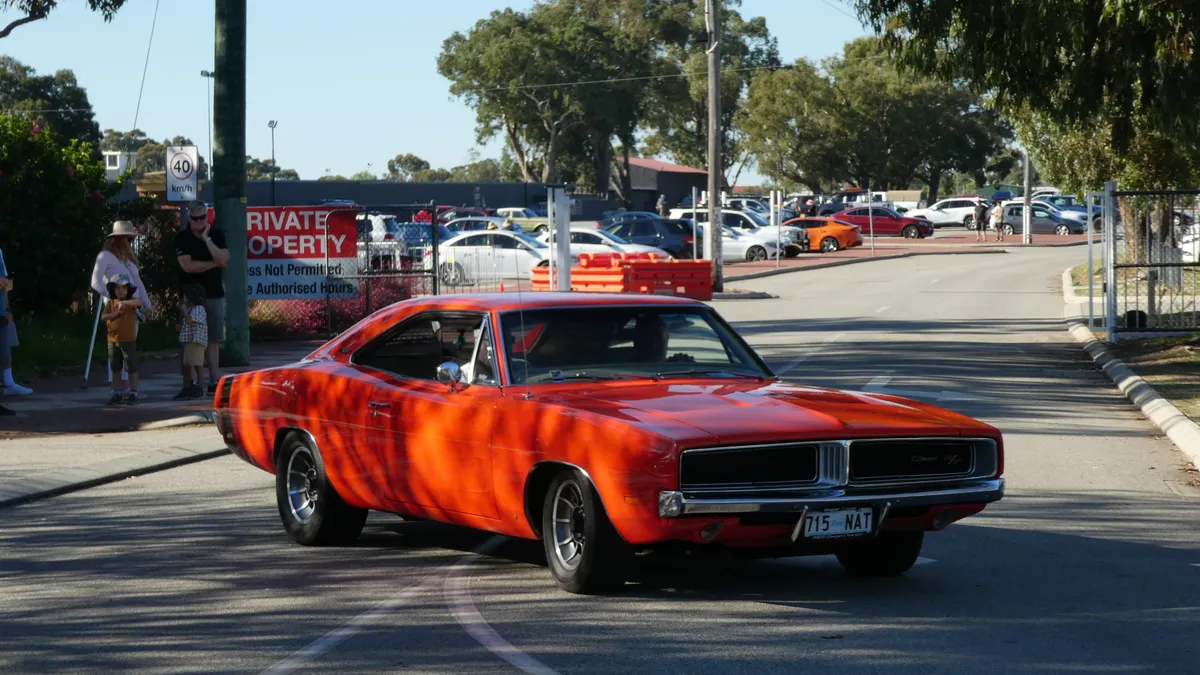
Why this vehicle matters
The 1968-70 Charger is the most recognizable muscle car silhouette ever drawn. The hidden headlights, tunneled rear glass, and Coke-bottle curves made it look like a spaceship from the future. Then Dodge dropped the 426 Hemi in it.
The Charger R/T (Road/Track) came standard with the 440 Magnum — 375 horsepower of reliable big-block power. The optional Hemi added another 50 hp and legendary status. Yes, the General Lee destroyed hundreds of these cars.
But the Charger's design transcends any TV show. This is what a muscle car is supposed to look like.
Patina notes
The second-gen Charger's complex body panels make rust repair expensive. The tunneled rear glass area is notorious for leaks and subsequent rust. Original B5 Blue, Plum Crazy, and Hemi Orange are the iconic colors.
The R/T stripe package defines the look. Hemi cars are absurdly valuable and heavily documented — fakes are detected quickly. The 440 is the sweet spot: real muscle car performance without Hemi prices. The standard 318 and 383 cars are sometimes converted to R/T clones.
Ownership reality
Mopar muscle car parts availability has improved dramatically but still lags GM and Ford. The specialty vendors know these cars cold. The engine bay is spacious and service-friendly.
The TorqueFlite automatic is one of the best transmissions ever built. The interior is surprisingly roomy. Air conditioning works well. However, the unibody construction means rust is structural, not cosmetic. A rusty Charger is exponentially more expensive to fix than a rusty Camaro.
The verdict
Buy if
You want the definitive muscle car look. You're prepared to pay Mopar tax on parts. You understand that a 440 car is 90% of the Hemi experience for 30% of the price.
Skip if
You need cheap parts availability. You're scared of unibody rust repair. You don't want to constantly explain that no, it's not the General Lee.
What to look for
- → Rear window/sail panel rust (hidden water trap)
- → Trunk floor and rear frame rail rust
- → Lower quarter panel rust at rocker junction
- → Fender broadcast sheet (validates options)
- → Hemi cars need extensive documentation
- → Frame rail rust behind front wheels
- → Floor pan rust under carpet
Common problems
- ⚠ Rear window leaks causing hidden rust
- ⚠ Unibody rust repair is expensive and difficult
- ⚠ Reproduction panels have fit issues
- ⚠ Power window mechanisms fail
- ⚠ Heater blower motor access is difficult
- ⚠ Carburetor issues with ethanol fuel
Parts & community
Parts sources
- Year One
- Classic Industries
- Mancini Racing
- AMD (Auto Metal Direct)
- Legendary Auto Interiors
Forums & communities
- ForBBodiesOnly.com
- Moparts Forums
- FABO (For A Bodies Only)
- MoparStyle.com
Sources
- Hagerty Valuation Tools · 2026-02-01
- Galen's Tag Service (Mopar decoding) · 2026-02-01
Specifications
| Engine | 440 Magnum V8 / 426 Hemi V8 |
| Power | 375-425 hp |
| Torque | 480-490 lb-ft |
| Transmission | 3-speed auto (TorqueFlite) / 4-speed manual |
| Drivetrain | RWD |
| Weight | 3,600 lbs |
| Wheelbase | 117 inches |
| Production | 89,199 (1969, all Chargers) |
Notable Features
- • Hidden headlights
- • Flying buttress rear window
- • General Lee from Dukes of Hazzard
- • 426 Hemi option
About Dodge
Chrysler's muscle brand. Dodge has always been the division willing to build something a little wilder than the competition.
View all Dodge vehicles →Find one
Looking to buy? Search current and past listings on Bring a Trailer.
Search on Bring a Trailer →