Why this vehicle matters
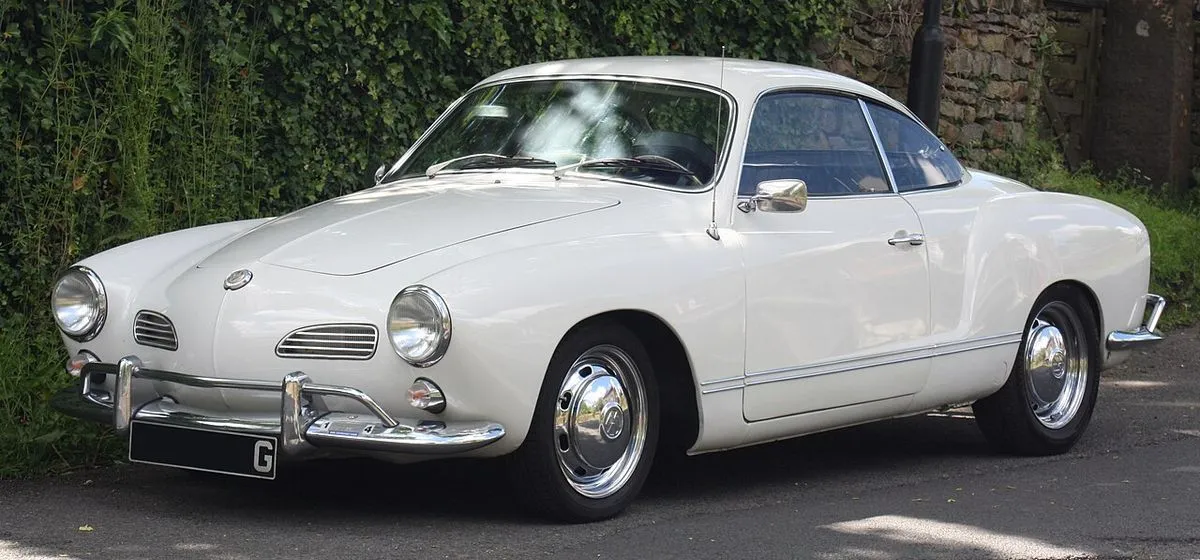
The Karmann Ghia is a sports car that isn't really a sports car — and that's exactly why people love it. Italian styling by Ghia, German construction by Karmann, built on Beetle running gear. It's gorgeous but slow. Romantic but practical.
A car for people who understand that driving pleasure isn't always about speed. Every Karmann Ghia on the road is a statement that beauty matters, even if you can't outrun a Civic.
Patina notes
The body lines on a Karmann Ghia are impossibly beautiful when original, and surprisingly hard to restore properly — the curves require hand-forming. Patina looks fantastic on these cars.
Original paint with decades of careful wax shows depth that respray can't match. The chrome bumpers and trim age gracefully. These are cars that get more beautiful as they wear.
Ownership reality
Everything mechanical is Beetle — which means the most well-supported classic car platform on Earth. Parts are cheap, plentiful, and available from multiple sources. The air-cooled community is welcoming to beginners.
Daily driver? Sure, if you're not in a hurry. The 53 hp engine struggles on hills and highway on-ramps, but cruising at 55 mph is pure joy.
The verdict
Buy if
You value style over speed. You want a classic car with Beetle reliability and parts support. You're comfortable being passed by everything on the road while looking better than all of them.
Skip if
You need to merge onto highways in traffic. You think 'sports car' means 'fast.' You can't handle constant compliments from strangers (seriously, these attract attention).
What to look for
- → Rust in the nose section (water collects there)
- → Floor pan condition (common Beetle weakness)
- → Body panel fit (reproductions don't fit well)
- → Heater channel rust (structural)
- → Frame head rust (under front fenders)
- → Convertible top frame condition (if applicable)
Common problems
- ⚠ Rust in predictable VW locations
- ⚠ Generator/alternator failures
- ⚠ Fuel system issues (carb rebuilds needed periodically)
- ⚠ Heater barely works (air-cooled limitation)
- ⚠ Drum brakes need frequent adjustment
- ⚠ Reproduction body panels don't fit well
Parts & community
Parts sources
- West Coast Metric
- CIP1
- Wolfsburg West
- The Samba classifieds
- ISP West
Forums & communities
- TheSamba.com
- Karmann Ghia Club of North America
- VW Vortex
- Ghia View
Sources
- Hagerty Valuation Tools · 2026-02-03
- Hemmings Motor News · 2026-02-03
Specifications
| Engine | 1.6L Air-Cooled Flat-4 |
| Power | 53 hp (1969) |
| Torque | 78 lb-ft |
| Transmission | 4-speed manual |
| Drivetrain | RWD |
| Weight | 1,875 lbs |
| Wheelbase | 94.5 inches |
| Production | 445,238 (Type 14 total) |
Notable Features
- • Italian design by Ghia
- • German coachbuilding by Karmann
- • Beetle mechanicals in sports car body
- • Available as coupe or convertible
About Volkswagen
The people's car. From Nazi-era origins to counterculture icon, VW became synonymous with simple, honest transportation.
View all Volkswagen vehicles →Find one
Looking to buy? Search current and past listings on Bring a Trailer.
Search on Bring a Trailer →