Why this vehicle matters
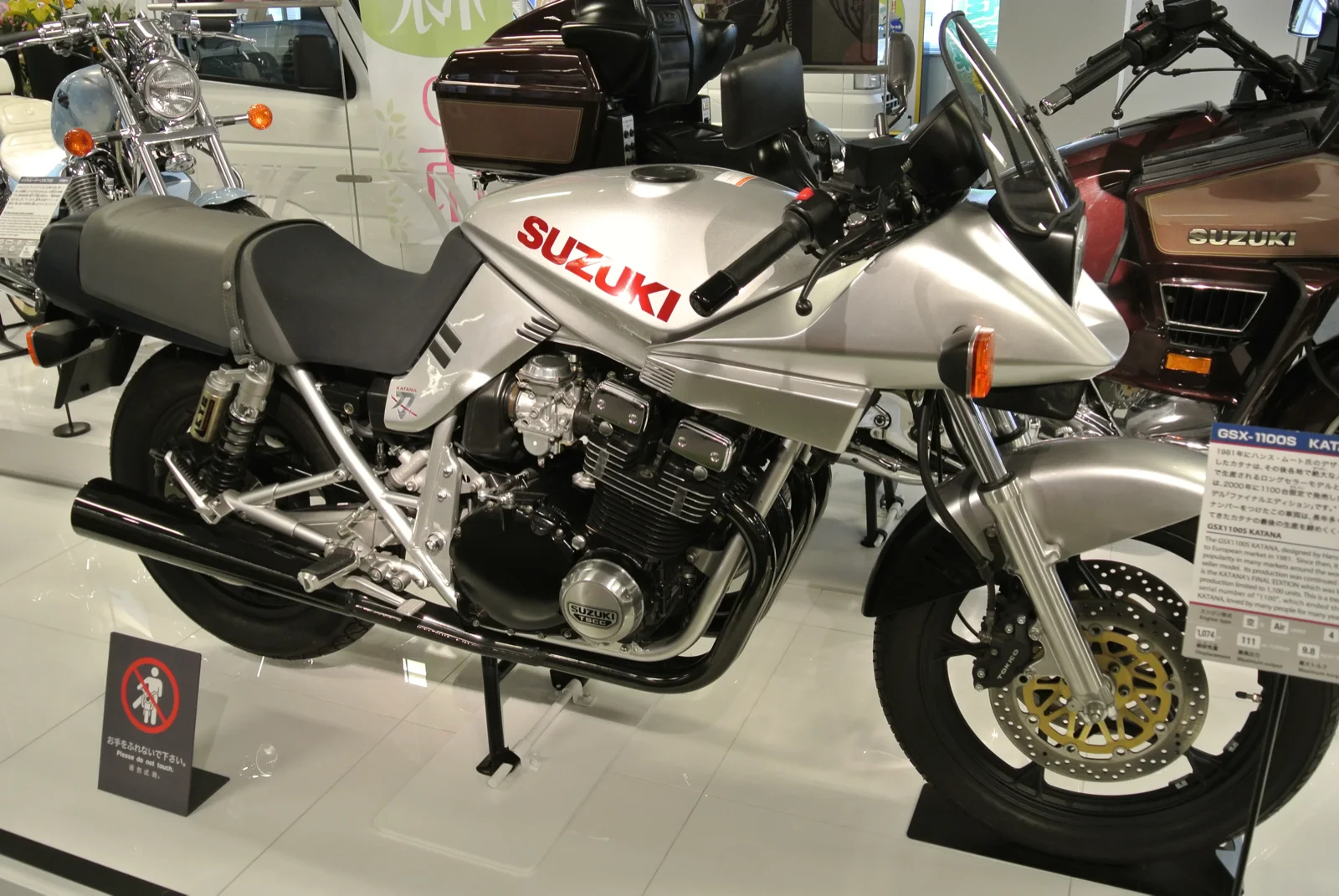
Hans Muth and his Target Design team looked at every motorcycle on the market in 1980, decided they were all ugly, and drew the Katana. The integrated fairing-tank-seat design was so radical that Suzuki executives initially rejected it.
They were wrong. The Katana didn't just look different — it proposed an entirely new visual language for motorcycles. Before the Katana, sportbikes looked like naked bikes with fairings bolted on. After the Katana, bodywork was a design statement.
Some people thought it was hideous. History proved them wrong. The Katana's influence shows up in every sportbike that treats bodywork as sculpture rather than afterthought. It was revolutionary, and it was right.
Patina notes
The Katana's bodywork is its identity — the flowing lines from fairing through tank to seat tail are one continuous design statement. Silver-over-red is the iconic color combination.
The integrated design means paint damage anywhere on the bodywork disrupts the visual flow. The bikini fairing's chin piece is vulnerable to stone chips.
These bikes were ridden hard by people who bought them because they were fast, not because they were design icons — which means honest road wear is common and authentic.
The engine is visually imposing — a large air-cooled four with cooling fins that accumulate decades of grime.
Ownership reality
The GSX1100 engine is one of Suzuki's all-time greats — reliable, powerful, and well-supported. The Katana shares its engine with the GSX1100E and other GS/GSX models, which means parts availability is excellent.
The chassis is less distinguished than the engine — adequate but not exceptional, with the 16-inch front wheel being the most common upgrade target (to 17-inch, for modern tire choices). Suspension upgrades are almost universal on ridden examples.
The bodywork is expensive to replace because of the integrated design — a crack in the fairing isn't just a fairing issue, it's a design integrity issue.
The Katana community is passionate and the bikes are mechanically straightforward for anyone comfortable with inline-fours.
The verdict
Buy if
You appreciate design that took a genuine risk and won. You want an early-1980s sportbike with one of the most reliable engines of its era. You understand that the Katana isn't just a fast motorcycle — it's a design manifesto.
Skip if
You want modern sportbike handling (the chassis needs help). You can't live with the 16-inch front wheel and limited tire selection. You think the styling is ugly — the Katana is polarizing and that's part of the point, but you need to be on the right side of that divide to enjoy owning one.
What to look for
- → Bodywork condition (integrated design means damage anywhere is costly)
- → Engine oil consumption (worn valve stem seals are common at this age)
- → Cam chain tensioner condition (check for top-end rattle)
- → Charging system output (stator and regulator/rectifier)
- → Front fork seal condition and anti-dive system function
- → Swingarm pivot bearings (heavy bike, bearings wear)
Common problems
- ⚠ Valve stem seal oil consumption (common on high-mileage examples)
- ⚠ Cam chain tensioner wear (manual conversion available)
- ⚠ Charging system failures (stator insulation breakdown)
- ⚠ 16-inch front wheel limits modern tire options
- ⚠ Bodywork cracking at stress points (mounting tabs, fairing lowers)
- ⚠ Carburetor synchronization (four CV carbs need regular attention)
Parts & community
Parts sources
- CMSNL.com (Dutch — comprehensive Suzuki catalog)
- eBay (strong GSX1100 parts community)
- Katana-specific specialists (several small operations)
- GSX1100 Forum classifieds
- Partzilla (OEM Suzuki parts)
Forums & communities
- Katana Planet (dedicated Katana forum)
- GSX1100 Owners Club
- Suzuki Katana Facebook groups
- Reddit r/motorcycles
Sources
- Bring a Trailer · 2026-02-28
- Motorcycle Classics · 2026-02-28
Specifications
| Engine | 1074cc DOHC air/oil-cooled inline-four |
| Power | 111 hp @ 8,500 rpm |
| Torque | 72 lb-ft @ 7,000 rpm |
| Transmission | 5-speed |
| Drivetrain | Chain |
| Weight | 545 lbs wet |
| Wheelbase | 60 inches |
| Production | High volume across 18-year production run |
Notable Features
- • Hans Muth / Target Design integrated bodywork
- • Integrated fairing/tank/seat design (no separate pieces)
- • Anti-dive front forks (early models)
- • 16-inch front wheel
About Suzuki
Small but mighty. Suzuki built motorcycles, kei cars, and tiny trucks that punched well above their weight class.
View all Suzuki vehicles →Find one
Looking to buy? Search current and past listings on Bring a Trailer.
Search on Bring a Trailer →