Why this vehicle matters
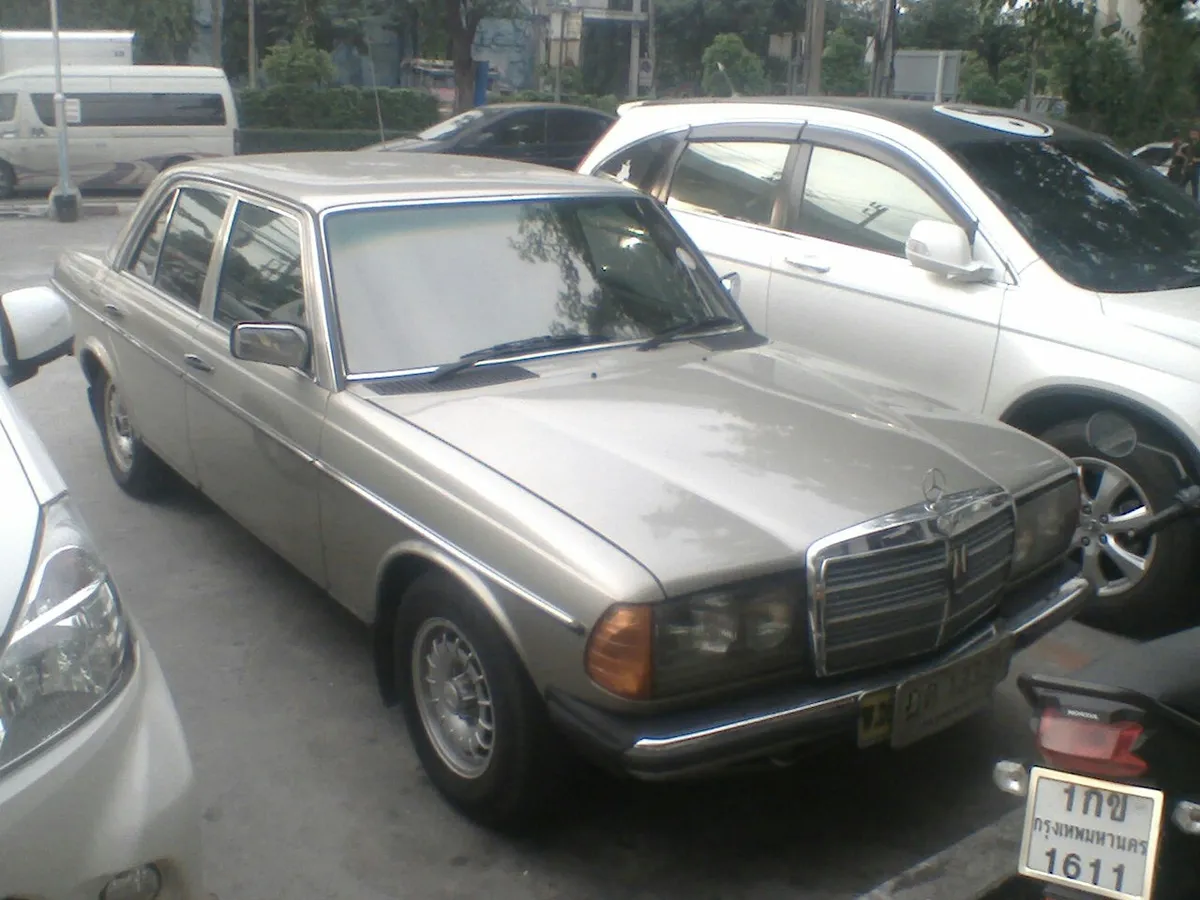
The W123 is the car that built Mercedes' reputation for indestructibility. Specifically, the 300D turbodiesel became the unofficial taxi of the third world, the eco-warrior's grease-car conversion platform, and the ultimate proof that German engineering could laugh at the odometer.
These cars routinely hit 300,000, 400,000, even 500,000 miles with original engines. The OM617 five-cylinder turbodiesel is considered one of the most reliable engines ever built.
While American cars were being strangled by early emissions equipment, the W123 diesel just kept clattering along, sipping fuel and refusing to die. The stacked headlights became an icon — a look that said 'serious car, serious engineering.'
Patina notes
The W123 wears patina with dignity. Faded paint, oxidized chrome, and interior wear just add to the taxi-cab-that-escaped-to-America aesthetic. These cars look right with some miles showing.
Over-restoration is almost counterproductive — the whole point of the W123 is that it's a working tool, not a show car. The ones that have been daily-driven for decades and still run are the purest expression of what Mercedes built.
Ownership reality
The W123 is Mercedes ownership for people who actually wrench. Parts are plentiful and inexpensive. The mechanical simplicity is the opposite of modern cars — you can diagnose most problems with your ears and basic tools.
The turbodiesel is slow by modern standards, but the torque makes it relaxing to drive. Join the W123 community; these cars have some of the most dedicated owner forums anywhere.
Expect to learn about glow plugs, vacuum systems, and the meditative hum of a five-cylinder diesel at idle.
The verdict
Buy if
You want a car that refuses to die. You're interested in running on alternative fuels. You appreciate engineering over excitement. You want to learn to maintain your own car on something that rewards the effort.
Skip if
You need speed. You want a quiet cabin. You're intimidated by DIY maintenance. You think a car should be retired after 100,000 miles.
What to look for
- → Rust in rocker panels, floor pans, and fenders
- → Glow plug system condition (cold starting)
- → Vacuum system integrity (controls everything)
- → Transmission condition (shift quality)
- → Turbo condition (oil leaks, wastegate function)
- → A/C compressor and system (often neglected)
Common problems
- ⚠ Vacuum system deterioration (Mercedes vacuum nightmare)
- ⚠ Glow plug failures (hard cold starts)
- ⚠ Climate control head failures
- ⚠ Rust in hidden areas (wheel wells, subframe)
- ⚠ Fuel injection pump timing
- ⚠ Window regulator failures
Parts & community
Parts sources
- Pelican Parts
- FCP Euro
- AutohausAZ
- RockAuto
- MercedesSource (diesel specialists)
- eBay (abundant used parts)
Forums & communities
- PeachParts Mercedes-Benz Forum
- Mercedes-Benz Club of America
- Dieselbenz.info
- MBWorld.org
Sources
- Hagerty Valuation Tools · 2026-02-04
- Mercedes-Benz Classic · 2026-02-04
Specifications
| Engine | 3.0L OM617 Inline-5 Turbodiesel |
| Power | 120 hp @ 4,350 rpm (turbocharged) |
| Torque | 170 lb-ft @ 2,400 rpm |
| Transmission | 4-speed automatic |
| Drivetrain | RWD |
| Weight | 3,400 lbs |
| Wheelbase | 110.0 inches |
| Production | Over 2.7 million W123s produced (all variants) |
Notable Features
- • Stacked quad headlights (European spec)
- • OM617 turbodiesel engine — legendary reliability
- • First turbocharged diesel passenger car sold in US
- • Tank-like build quality
- • Run on waste vegetable oil with conversion
About Mercedes-Benz
The three-pointed star. Mercedes-Benz invented the automobile, then spent a century proving they still knew how to build one.
View all Mercedes-Benz vehicles →Find one
Looking to buy? Search current and past listings on Bring a Trailer.
Search on Bring a Trailer →