Why this vehicle matters
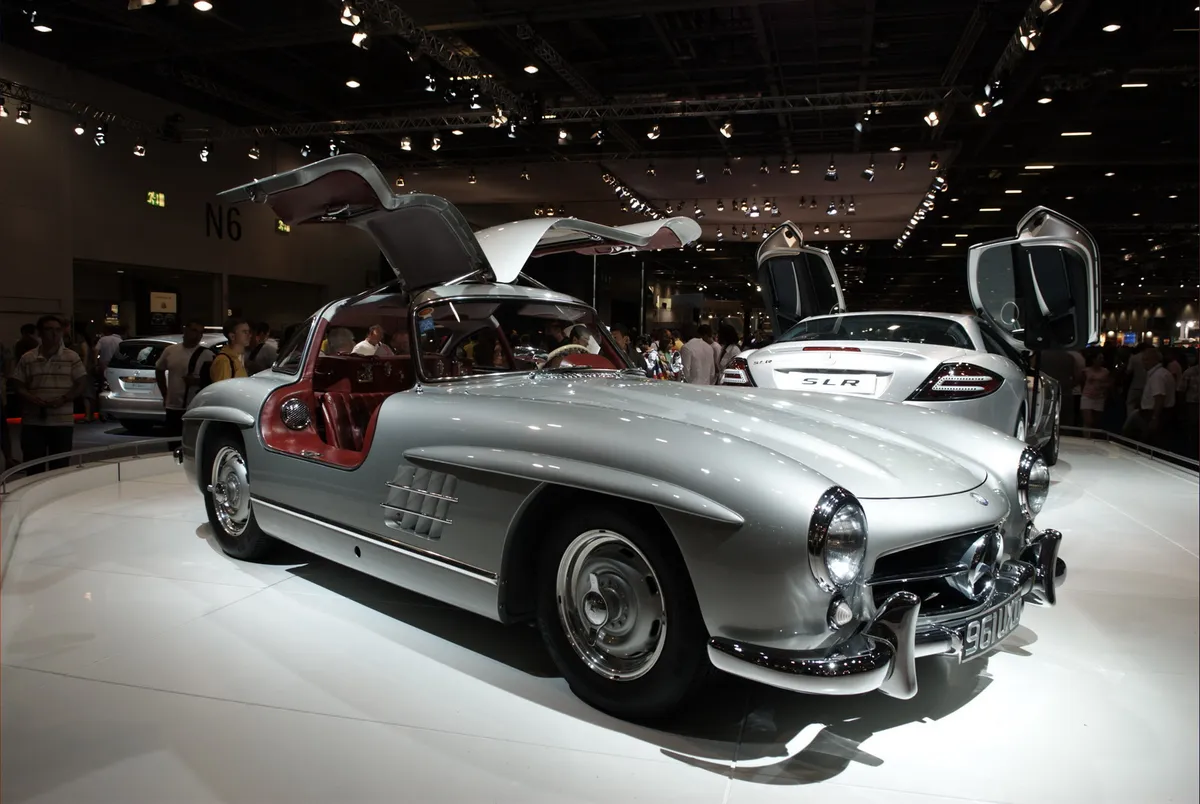
The 300SL is where Mercedes-Benz became a legend. Born from the W194 racing program that dominated Le Mans and the Carrera Panamericana, the road car was essentially a race car with headlights and a heater.
Those gullwing doors weren't a styling gimmick — they were an engineering necessity, required by the tubular space frame chassis that made the car so rigid and light.
The Bosch mechanical fuel injection was a world first for a production car, adding 50 hp over the carbureted racing engine. Max Hoffman, the legendary New York importer, convinced Mercedes to build it. The result was the first supercar — decades before that term existed.
Patina notes
Original 300SLs are too valuable to show wear. Concours restoration is the norm, and values support it. The aluminum-bodied examples are the rarest — only 29 built. Even driver-quality examples command seven figures. These are investment-grade collectibles that happen to be driveable.
Ownership reality
A 300SL Gullwing is an investment first, a car second. The fuel injection system is finicky and requires specialists who understand the Bosch mechanical setup. Parts are available through Mercedes-Benz Classic.
The gullwing doors require the tilt-away steering wheel to enter — there's no graceful way in or out. At this price point, you're not just buying a car; you're joining a community of curators.
The verdict
Buy if
You have seven figures for the ultimate mid-century sports car. You want racing DNA with road manners. You appreciate that form followed function — the doors, the injection, the frame — all engineering first.
Skip if
You want something you can drive casually. You need practical ingress/egress. Your investment portfolio doesn't include aluminum and steel.
What to look for
- → Matching numbers (engine, gearbox, differential)
- → Frame integrity (tubular space frame corrosion)
- → Fuel injection system condition
- → Door hinge and strut mechanism wear
- → Body authenticity (steel vs aluminum)
- → Documentation and provenance
Common problems
- ⚠ Fuel injection system requires specialized knowledge
- ⚠ Overheating in traffic (racing-derived cooling)
- ⚠ Door mechanism wear and adjustment
- ⚠ Drum brakes (adequate but period-correct)
- ⚠ Swing axle rear suspension behavior at limits
Parts & community
Parts sources
- Mercedes-Benz Classic Center
- HK Engineering (Germany)
- Rudi & Company
- Gullwing Motor Cars
Forums & communities
- Mercedes-Benz Club of America (300SL section)
- Gullwing Group International
- 300SL.org
Sources
- Mercedes-Benz Classic · 2026-02-04
- Hagerty Valuation · 2026-02-04
Specifications
| Engine | 3.0L M198 I6 with Bosch mechanical fuel injection |
| Power | 215 hp @ 5,800 rpm |
| Torque | 203 lb-ft @ 4,600 rpm |
| Transmission | 4-speed manual |
| Drivetrain | RWD |
| Weight | 2,850 lbs |
| Wheelbase | 94.5 inches |
| Production | 1,400 Gullwing coupes (W198 I) |
Notable Features
- • Iconic gullwing doors (necessary due to tubular space frame)
- • First production car with direct fuel injection
- • Derived from W194 racing car
- • Tilting steering wheel for entry/exit
- • Optional aluminum body (29 examples)
About Mercedes-Benz
The three-pointed star. Mercedes-Benz invented the automobile, then spent a century proving they still knew how to build one.
View all Mercedes-Benz vehicles →Find one
Looking to buy? Search current and past listings on Bring a Trailer.
Search on Bring a Trailer →