Why this vehicle matters
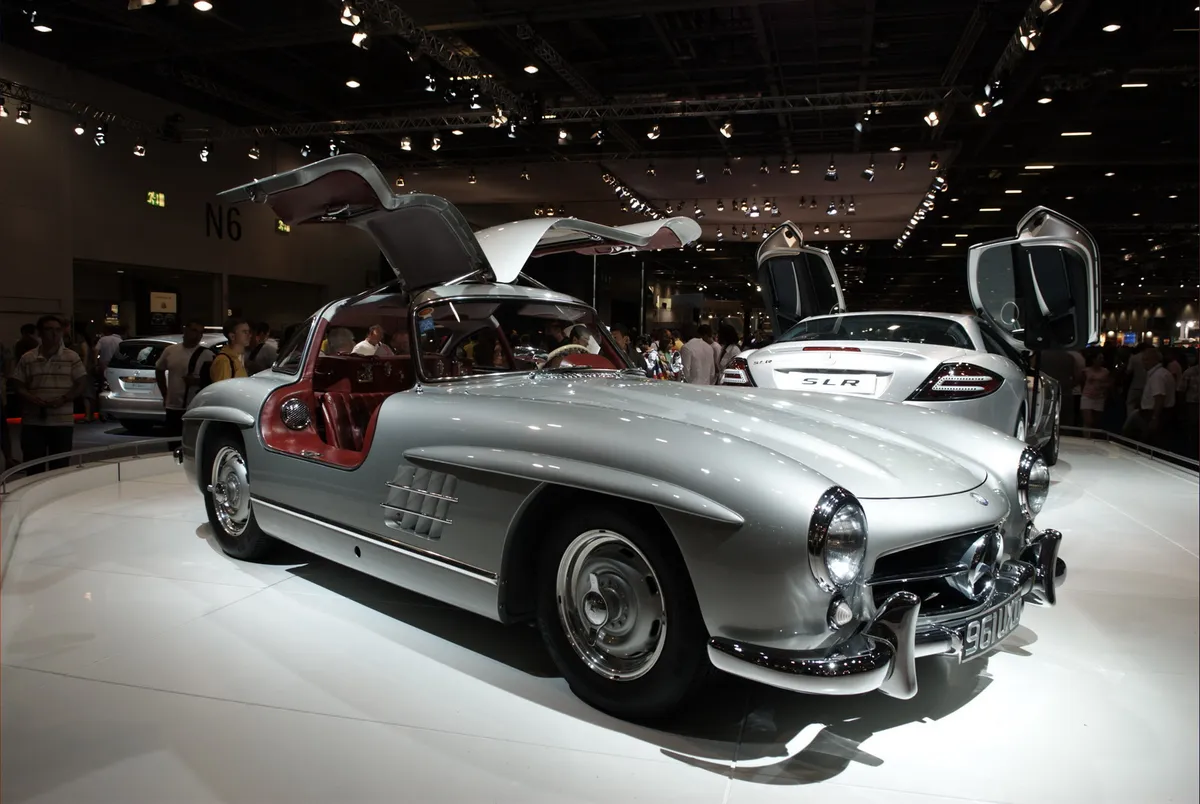
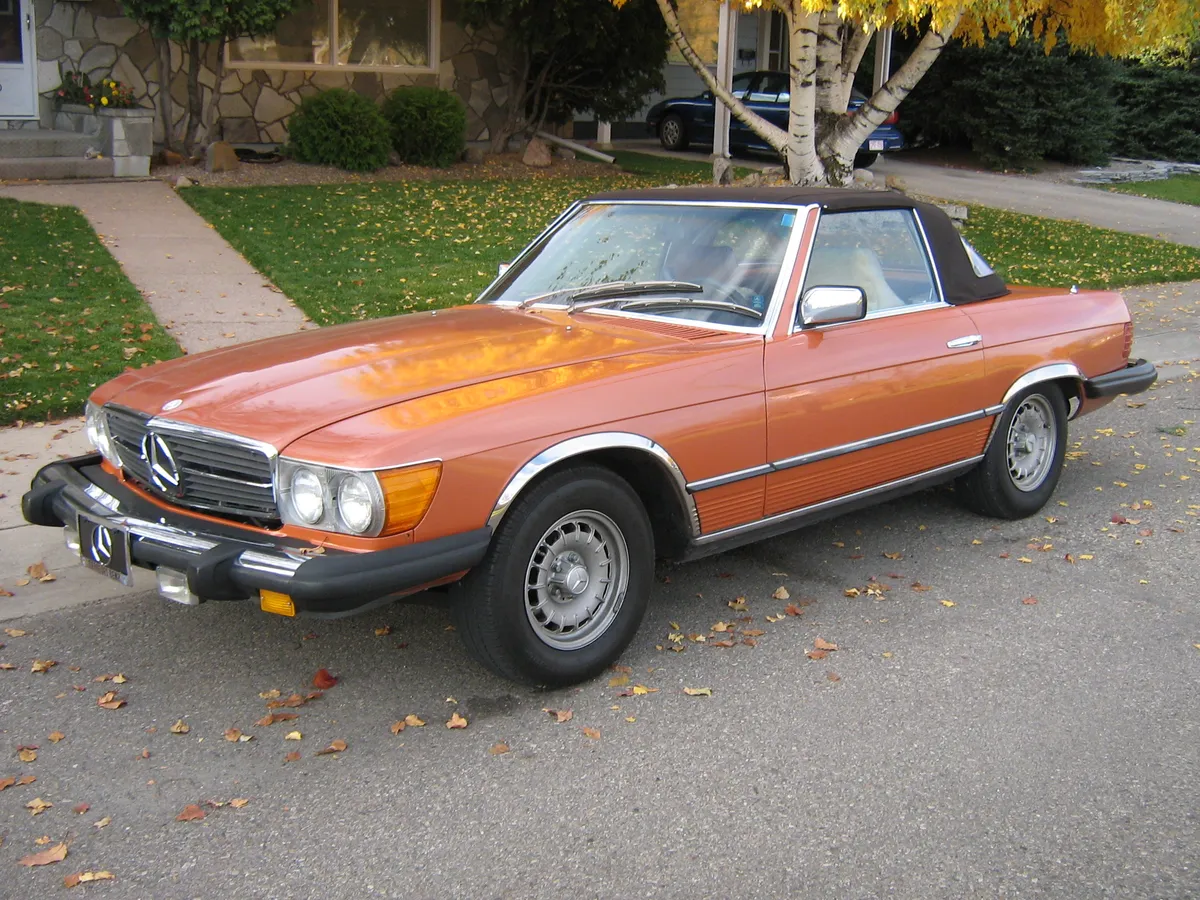
The R107 SL is what happens when Mercedes builds a sports car for grown-ups. Where the 300SL was a race car with plates, the R107 was a gentleman's express — fast enough, comfortable enough, and built like a bank vault.
It ran from 1971 to 1989, making it the longest-produced Mercedes model ever. While American manufacturers were fumbling through the malaise era with smog-choked engines and questionable build quality, Mercedes just kept refining the R107.
The 450SL hit the sweet spot: enough V8 torque to move with authority, none of the early emission-control headaches of the smaller engines, and all the presence of the big-dollar 560SL without the collector premium.
Patina notes
R107s age gracefully. The chrome and paint hold up remarkably well, and light wear suits them. These aren't trailer queens — they were built to be driven. A well-maintained driver with honest patina is more authentic than an over-restored show car.
The wood trim oxidizes, the leather develops character, and the whole package just looks better with some miles on it.
Ownership reality
This is the accessible Mercedes classic. Parts are abundant, and any Mercedes specialist knows these cars. The V8 engines are bulletproof with basic maintenance. The automatic transmission is Mercedes' own unit and nearly indestructible.
Air conditioning works well. The biggest maintenance items are the fuel injection (CIS, requires specialists) and the soft top mechanism. Join the Mercedes-Benz Club of America — the knowledge base is deep and the community is welcoming.
The verdict
Buy if
You want a classic Mercedes experience without six-figure investment. You appreciate build quality over raw performance. You want a convertible that's actually comfortable on long drives.
Skip if
You want sports car handling. You need modern fuel economy. You're looking for an investment vehicle — these are for driving, not flipping.
What to look for
- → Rust in rocker panels and floor pans
- → Subframe mounting points condition
- → Hard top mounting hardware (often missing)
- → Soft top condition and hydraulics
- → A/C system function (expensive to repair)
- → Fuel injection system behavior (warm start issues)
Common problems
- ⚠ Vacuum system deterioration (controls many functions)
- ⚠ Climate control head failures
- ⚠ Fuel injection warm-start issues
- ⚠ Soft top hydraulic leaks
- ⚠ Heater valve failures
- ⚠ Rust in hidden areas (check carefully)
Parts & community
Parts sources
- Mercedes-Benz Classic Center
- Pelican Parts
- AutohausAZ
- FCP Euro
- RockAuto
Forums & communities
- Mercedes-Benz Club of America
- BenzWorld.org
- MBWorld.org
- PeachParts Mercedes-Benz Forum
Sources
- Hagerty Valuation Tools · 2026-02-04
- Mercedes-Benz Classic · 2026-02-04
Specifications
| Engine | 4.5L M117 V8 |
| Power | 225 hp @ 5,000 rpm (Euro spec) |
| Torque | 278 lb-ft @ 3,000 rpm |
| Transmission | 3-speed automatic (4-speed manual rare) |
| Drivetrain | RWD |
| Weight | 3,500 lbs |
| Wheelbase | 96.9 inches |
| Production | Over 300,000 R107s produced (all variants) |
Notable Features
- • 18-year production run (longest Mercedes model)
- • Removable hardtop included from factory
- • Soft top stores under hard tonneau
- • Available in 280SL, 350SL, 380SL, 420SL, 450SL, 500SL, 560SL variants
- • Legendary build quality and reliability
About Mercedes-Benz
The three-pointed star. Mercedes-Benz invented the automobile, then spent a century proving they still knew how to build one.
View all Mercedes-Benz vehicles →Find one
Looking to buy? Search current and past listings on Bring a Trailer.
Search on Bring a Trailer →