Why this vehicle matters
The 850 Mk III is the last chapter of Norton's story, and like most last chapters, it's complicated. By 1975, Norton knew they were dying. The Japanese had won the horsepower war, the reliability war, and the price war.
Norton's response was to add what customers kept asking for: electric start, rear disc brake, left-side shift for the American market, and more displacement. On their own merits, these were sensible improvements.
The 828cc engine makes more torque lower in the rev range, the electric start actually works (most of the time), and the rear disc is a genuine safety upgrade.
But the added weight — 30 pounds over the 750 — dulled the handling that was the Commando's entire reason for existing. The Mk III is Norton waving a white flag while still trying to fight, and there's something both admirable and heartbreaking about that.
Patina notes
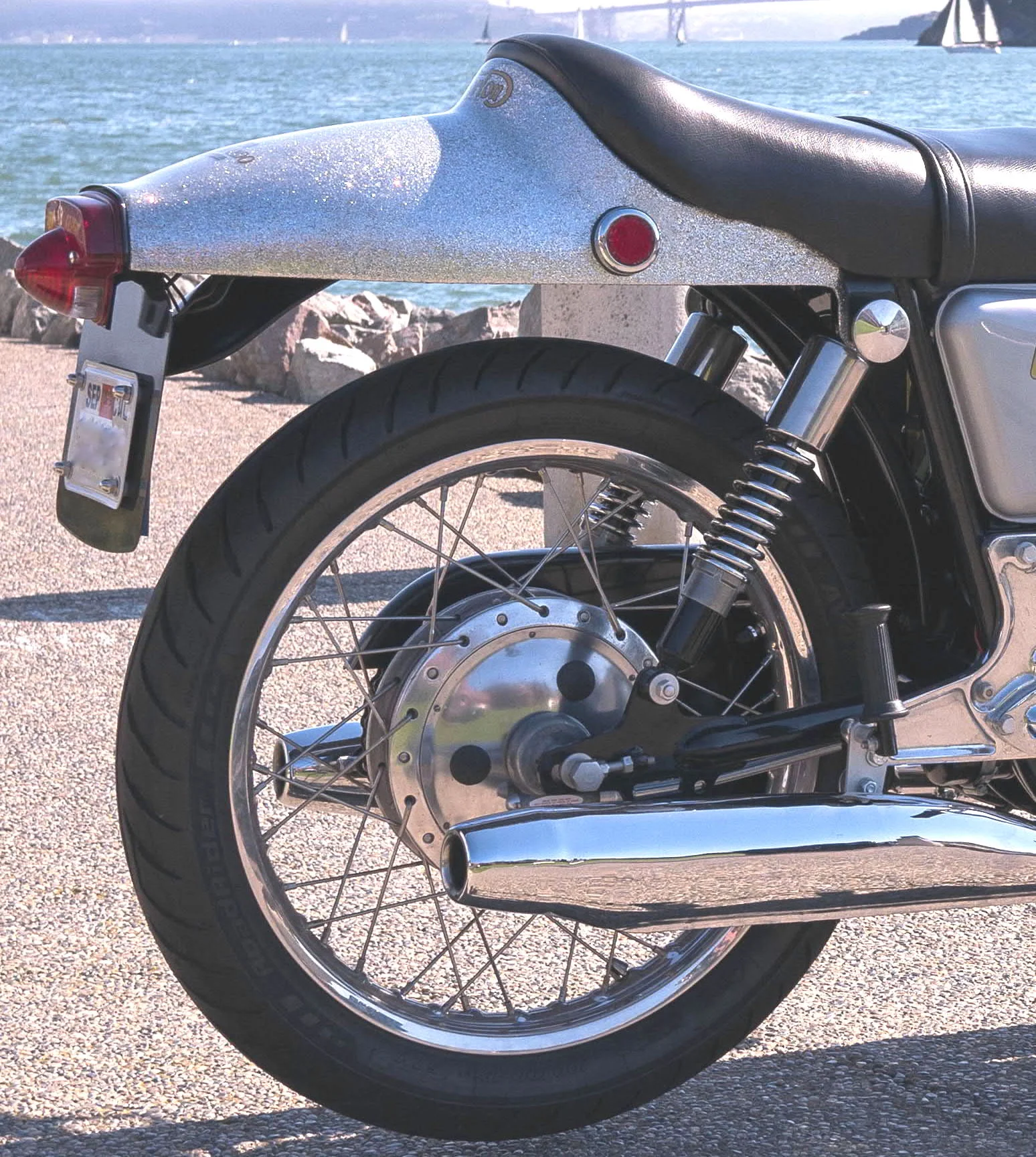
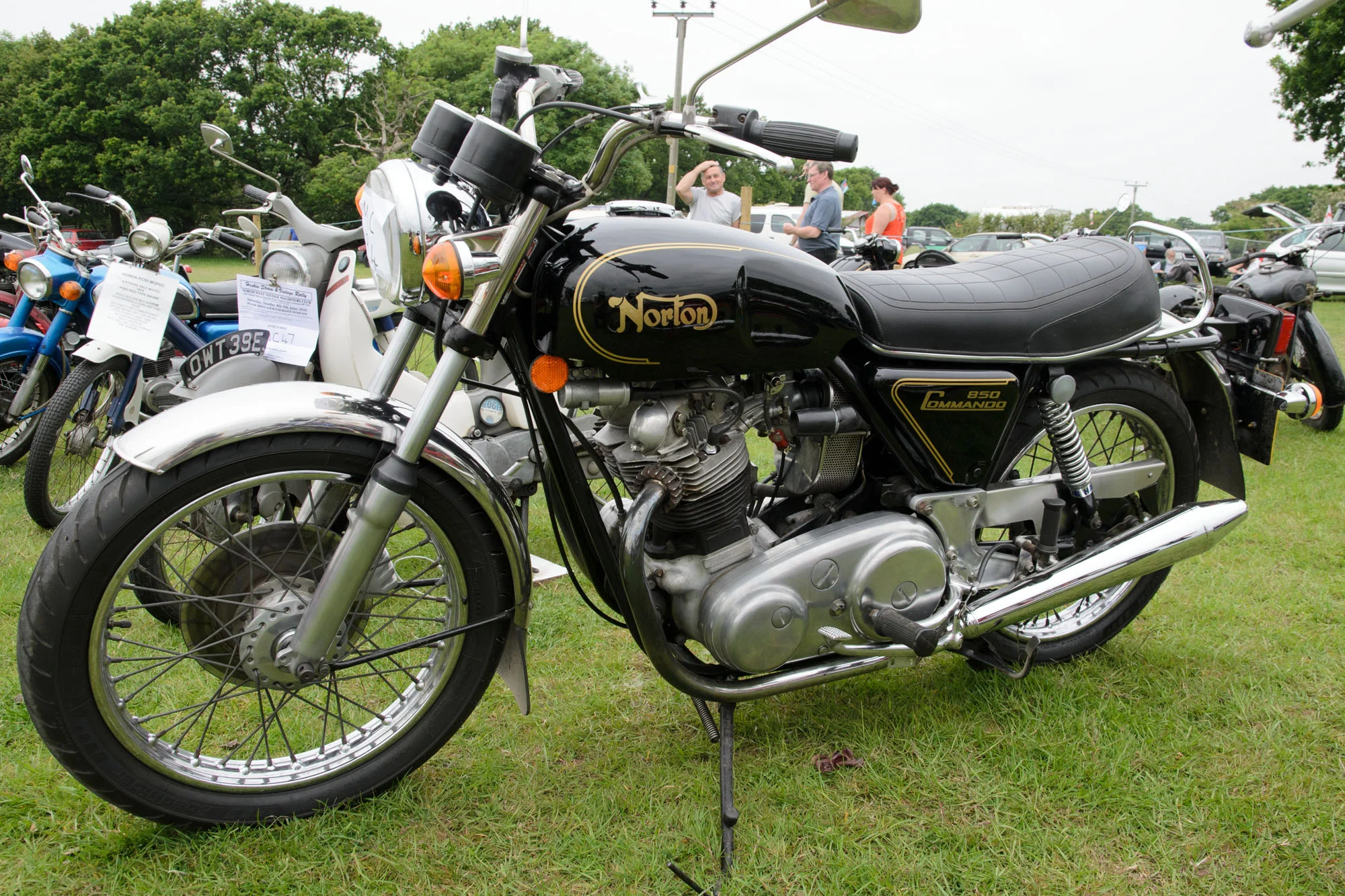
The 850 ages slightly differently from the 750 due to its later-era components. The annular discharge silencers (the flat-ended cans) discolor more evenly than the earlier peashooters — they go from chrome to a uniform bronze patina that's actually quite handsome.
The electric start motor and its associated wiring add visual complexity to the right side of the engine that the 750 never had, and this area tends to collect road grime in ways that emphasize the added bulk.
The Mk III's black-painted frame shows stone chips more readily than the earlier silver. Switchgear is Japanese-sourced (Wipac/Japanese hybrid) and deteriorates faster than the earlier Lucas items, ironically.
The vernier Isolastic adjusters, while functionally superior to the shimmed originals, look more industrial and less purposeful as they age.
Ownership reality
The 850 Mk III is genuinely the most practical Commando to own as a rider. The electric start transforms the ownership experience — no more memorizing the kick-start ritual, no more flooded cylinders in cold parking lots, no more embarrassing failed starts at gas stations.
The extra torque from the bigger engine means you can be lazier with gear changes, which is welcome given the still-mediocre four-speed box. The rear disc brake is a meaningful safety improvement.
But you're paying for these conveniences in added weight and complexity. The starter motor and its reduction gears are another system to maintain, and the charging system works harder to keep up with the starter's demands.
The Isolastic system still needs attention, and the heavier engine loads the rubbers faster. Think of the 850 as the Commando for people who want to ride rather than tinker — it's less pure but more useful.
The verdict
Buy if
You want a Commando you can actually use as regular transport without the kick-start drama. You value the extra torque for real-world riding over the 750's slightly sharper handling. You're buying a rider, not a collector piece, and you appreciate that the 850's lower market value means you can afford to actually ride it instead of worrying about mileage and condition. The Mk III is the overlooked Commando, and that's exactly why it's the smart buy.
Skip if
You want the definitive Commando experience — that's the 750 Roadster or Fastback, and the handling difference is real, not imagined. You're a collector focused on appreciation — the 850 will never command 750 money. You're frustrated by British electrical systems and the idea of adding an electric starter motor and its wiring to the existing Lucas nightmare makes you twitch. Or you need a reliable daily rider — the 850 is more practical than the 750 but it's still a 1970s British motorcycle, and that phrase carries obligations.
What to look for
- → Electric starter function — test it cold, test it hot, listen for the reduction gears grinding
- → Charging system output — the alternator needs to cope with starter motor demands
- → Isolastic mount condition — the heavier engine accelerates wear
- → Rear disc brake caliper condition — early Lockheed calipers seize if neglected
- → Engine bore condition — the 828cc overbore leaves thinner cylinder walls than the 750
- → Left-side gearshift conversion quality on US models — some were poorly executed
- → Frame cracking at swingarm pivot — the extra weight loads this area harder
- → Gearbox condition — same basic box as the 750, now handling more torque
Common problems
- ⚠ Electric starter reduction gear failure — the fiber gear strips, leaving you with a very heavy kick-start bike
- ⚠ Charging system inadequacy — the stock alternator barely keeps up with the starter and lights combined
- ⚠ Isolastic rubber compression — accelerated by the heavier engine, needs more frequent shimming
- ⚠ Oil consumption from worn 828cc bores — the overbore is less forgiving of wear
- ⚠ Rear brake caliper seizure — Lockheed calipers need regular servicing or replacement
- ⚠ Starter solenoid failure — intermittent starting that mimics dead battery
- ⚠ Gearbox mainshaft bearing wear — more torque, same bearings
- ⚠ Wiring harness deterioration — the more complex loom degrades faster than the 750's simpler system
Parts & community
Parts sources
- Andover Norton (UK) — comprehensive Norton parts including Mk III specific items
- RGM Motors (UK) — Norton specialist with 850 expertise
- Fair Spares (Australia) — Commando reproduction parts
- Old Britts (USA) — Mk III specific parts and upgrade kits
- Colorado Norton Works (USA) — performance rebuilds and charging system upgrades
- Norvil Motorcycle Co. (UK) — complete Commando parts inventory
Forums & communities
- Norton Owners Club (nortonownersclub.org)
- Access Norton (accessnorton.com)
- INOA (International Norton Owners Association)
- British Bike Forum (britishbikeforum.co.uk)
Sources
- Norton Commando Restoration Manual by Norman White · 2026-02-28
- Access Norton — Mk III Technical Reference · 2026-02-28
- Classic Bike Magazine — 850 Commando Buyer's Guide · 2026-02-28
Specifications
| Engine | 828cc OHV air-cooled parallel twin |
| Power | 60 hp @ 6,000 rpm |
| Torque | 50 lb-ft @ 5,000 rpm |
| Transmission | 4-speed constant-mesh |
| Drivetrain | Chain |
| Weight | 460 lbs |
| Wheelbase | 57 inches |
| Production | Approximately 12,000 units (Mk III, 1975-1977) |
Notable Features
- • Electric start
- • 828cc bored-out engine
- • Rear disc brake
- • Left-side gearshift (US models)
- • Isolastic engine mounting system
- • Annular discharge silencers
- • Vernier Isolastic adjustment
About Norton
The racing aristocrat of British motorcycles. Norton won more Isle of Man TTs than anyone.
View all Norton vehicles →Find one
Looking to buy? Search current and past listings on Bring a Trailer.
Search on Bring a Trailer →