Why this vehicle matters
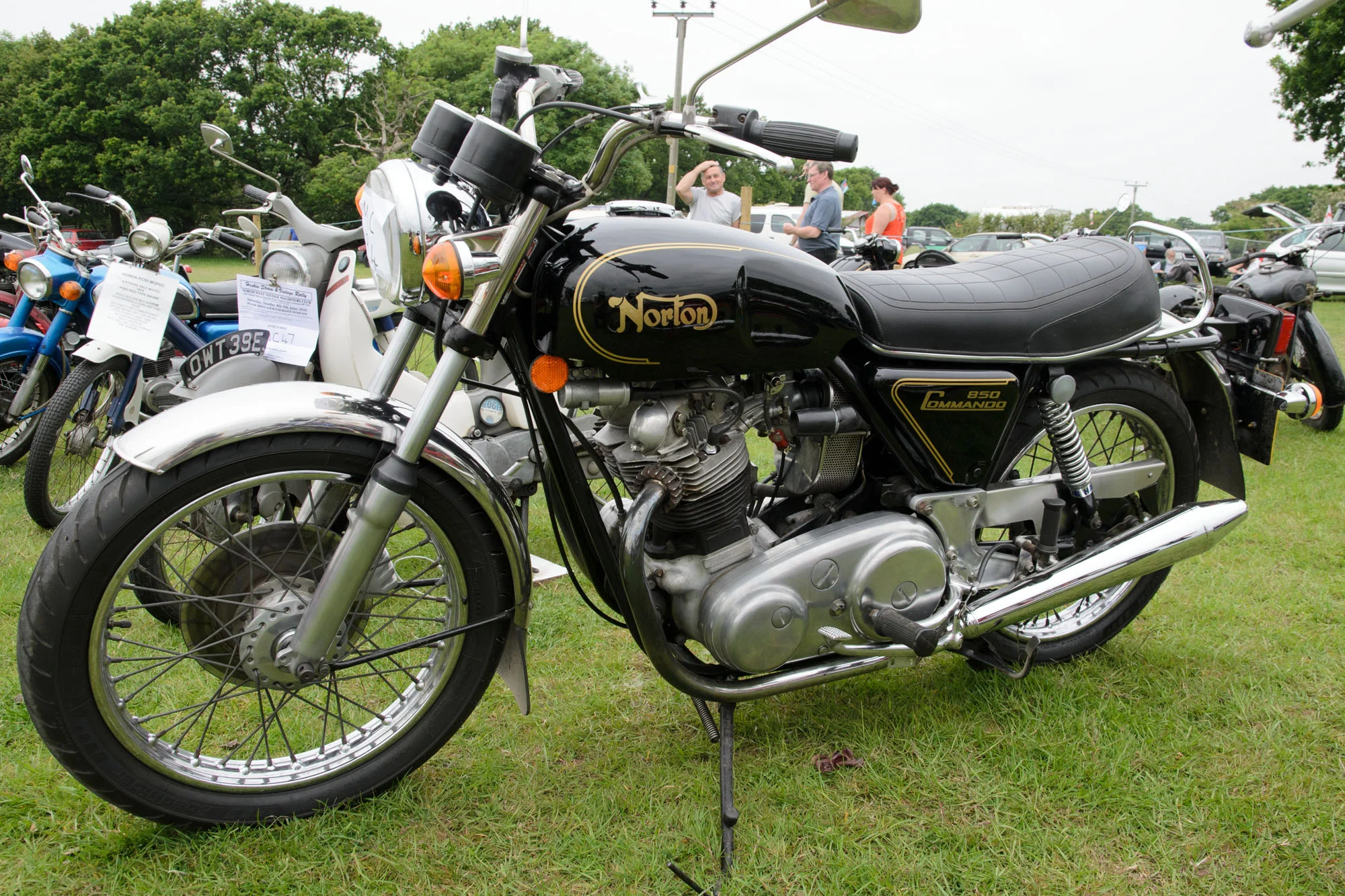
The Commando was Norton's Hail Mary — and it worked, spectacularly, for a while. In 1968, the British motorcycle industry was already losing the war against Japan, and Norton's answer was to take their aging but characterful 750 Atlas twin and solve its one unforgivable flaw: vibration.
The Isolastic mounting system — rubber-mounting the entire engine, gearbox, and swingarm as a unit within the frame — was an engineering stroke of genius that eliminated the buzz that made every other British parallel twin a fillings-loosening experience at highway speed.
It worked so well that the Commando won Motor Cycle News Machine of the Year five consecutive times, 1968-1972, beating the Honda CB750 and Kawasaki Z1 on their own turf.
The Commando proved that character and handling could still matter more than specification sheets, right up until the moment the money ran out.
Patina notes
Commandos develop a working-bike patina that's deeply appealing. The engine cases, being aluminum, oxidize to a soft grey that looks purposeful against the black barrels.
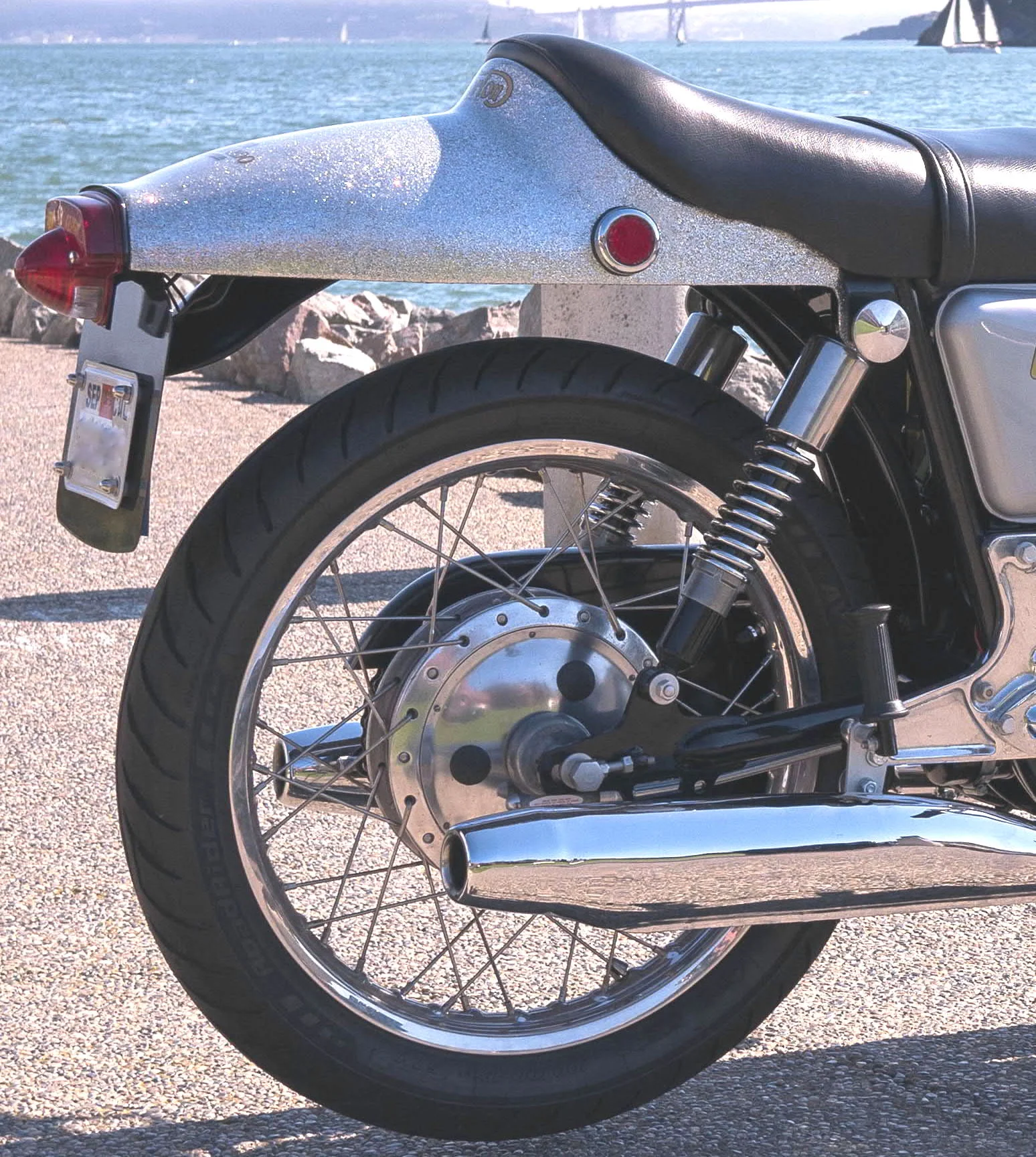
Chrome exhausts pit and discolor from heat cycling — the header pipes take on a golden-bronze tint near the head that's almost ornamental. Paint on the Fastback tail section checks at the edges where vibration (yes, the Isolastics don't eliminate all of it) works on the finish.
The alloy wheel rims corrode where spokes meet rim if water gets in. The Isolastic rubbers themselves perish and compress over time, which actually changes how the bike looks at rest — a saggy Commando with collapsed Isolastics sits differently than a fresh one.
Original transfers (not decals — Norton used water-slide transfers) deteriorate beautifully, and reproductions never quite match the weight and transparency of the originals.
Ownership reality
The Commando is the most rideable classic British twin, full stop. When the Isolastics are properly shimmed and adjusted, the 750 pulls cleanly from 2,000 rpm to redline without threatening to vibrate your mirrors off.
The handling — thanks to that Featherbed heritage — is still genuinely good by modern standards: predictable, confidence-inspiring, with a neutral steering feel that makes experienced riders grin.
The four-speed gearbox is the weak point; it's adequate but nothing more, and finding neutral at a stoplight can be an adventure. Oil leaks are a given — carry rags. Electrics are Lucas, so carry spare fuses too.
But the Commando rewards sympathetic riding like few other bikes. Learn to read the engine's mood, keep the Isolastics shimmed, and it's a motorcycle that makes modern bikes feel sterile.
Avoid the 1972 Combat engine specification at all costs — Norton bumped compression and cam timing for more power and destroyed reliability in the process.
The verdict
Buy if
You want the best-handling, most characterful British twin ever made and you're willing to learn the Isolastic shimming ritual that keeps it happy. You appreciate that 58 horsepower in a 430-pound chassis with world-class geometry is a more interesting riding experience than 150 horsepower you can never use. You want a classic that you can actually ride — properly ride — on modern roads without feeling like you're operating a museum exhibit.
Skip if
You want reliability that approaches Japanese standards. You're not comfortable with oil leaks as a permanent feature of motorcycle ownership. You need more than four gears. And absolutely, categorically, skip any Commando advertised as a 'Combat' engine unless it's been rebuilt to standard compression with proper bearings — the Combat spec was Norton's worst engineering decision and the main bearings will remind you of that at the most inconvenient possible moment.
What to look for
- → Isolastic mount condition — worn rubbers and incorrect shimming ruin the entire point of the bike
- → Combat engine identification (1972 models) — check compression ratio and cam timing if in doubt
- → Frame cracks at the steering head, particularly on early Fastback models
- → Main bearing condition — spin the engine by hand and listen for rumble
- → Gearbox engagement — test all four gears under load and check for jumping out of second
- → Primary chain adjuster — if maxed out, the chain and sprockets need replacement
- → Exhaust header pipe condition — originals rot from the inside
- → Disc brake conversion quality on later models — some aftermarket conversions are poor
Common problems
- ⚠ Isolastic rubber deterioration — needs checking and shimming every few thousand miles, ignored by most owners
- ⚠ Main bearing failure on Combat engines — the higher compression loads the plain bearings beyond their design limit
- ⚠ Gearbox second-gear engagement issues — worn selector forks and dogs
- ⚠ Primary chain tensioner blade wear — causes rattling and eventual chain derailment
- ⚠ Oil leaks from the crankcase joint, pushrod tubes, and primary chaincase
- ⚠ Lucas electrical failures — alternator stator burnout and rectifier/zener diode issues
- ⚠ Steering head bearing wear — accelerated if Isolastics are neglected
- ⚠ Exhaust collet failure — the distinctive exhaust nut arrangement works loose
Parts & community
Parts sources
- Andover Norton (UK) — the definitive Norton parts supplier
- RGM Motors (UK) — Norton specialist with extensive Commando inventory
- Fair Spares (Australia) — Commando-specific reproduction parts
- Old Britts (USA) — comprehensive Commando parts catalog
- Colorado Norton Works (USA) — performance upgrades and rebuilds
- Norvil Motorcycle Co. (UK) — Commando parts and complete bikes
Forums & communities
- Norton Owners Club (nortonownersclub.org)
- Access Norton (accessnorton.com)
- British Bike Forum (britishbikeforum.co.uk)
- INOA (International Norton Owners Association)
Sources
- Norton Commando Bible by Peter Henshaw · 2026-02-28
- Access Norton — Commando Technical Reference · 2026-02-28
- Motor Cycle News Archive — Machine of the Year · 2026-02-28
Specifications
| Engine | 745cc OHV air-cooled parallel twin |
| Power | 58 hp @ 6,500 rpm |
| Torque | 45 lb-ft @ 5,500 rpm |
| Transmission | 4-speed constant-mesh |
| Drivetrain | Chain |
| Weight | 430 lbs |
| Wheelbase | 56.5 inches |
| Production | Approximately 60,000 units total (all variants, 1968-1977) |
Notable Features
- • Isolastic rubber engine mounting system
- • Featherbed-derived frame
- • Roadholder front forks
- • Twin leading shoe front drum brake (early) / disc (later)
- • Fastback / Roadster / Interstate variants
- • Peashooter or black cap silencers
About Norton
The racing aristocrat of British motorcycles. Norton won more Isle of Man TTs than anyone.
View all Norton vehicles →Find one
Looking to buy? Search current and past listings on Bring a Trailer.
Search on Bring a Trailer →