Why this vehicle matters
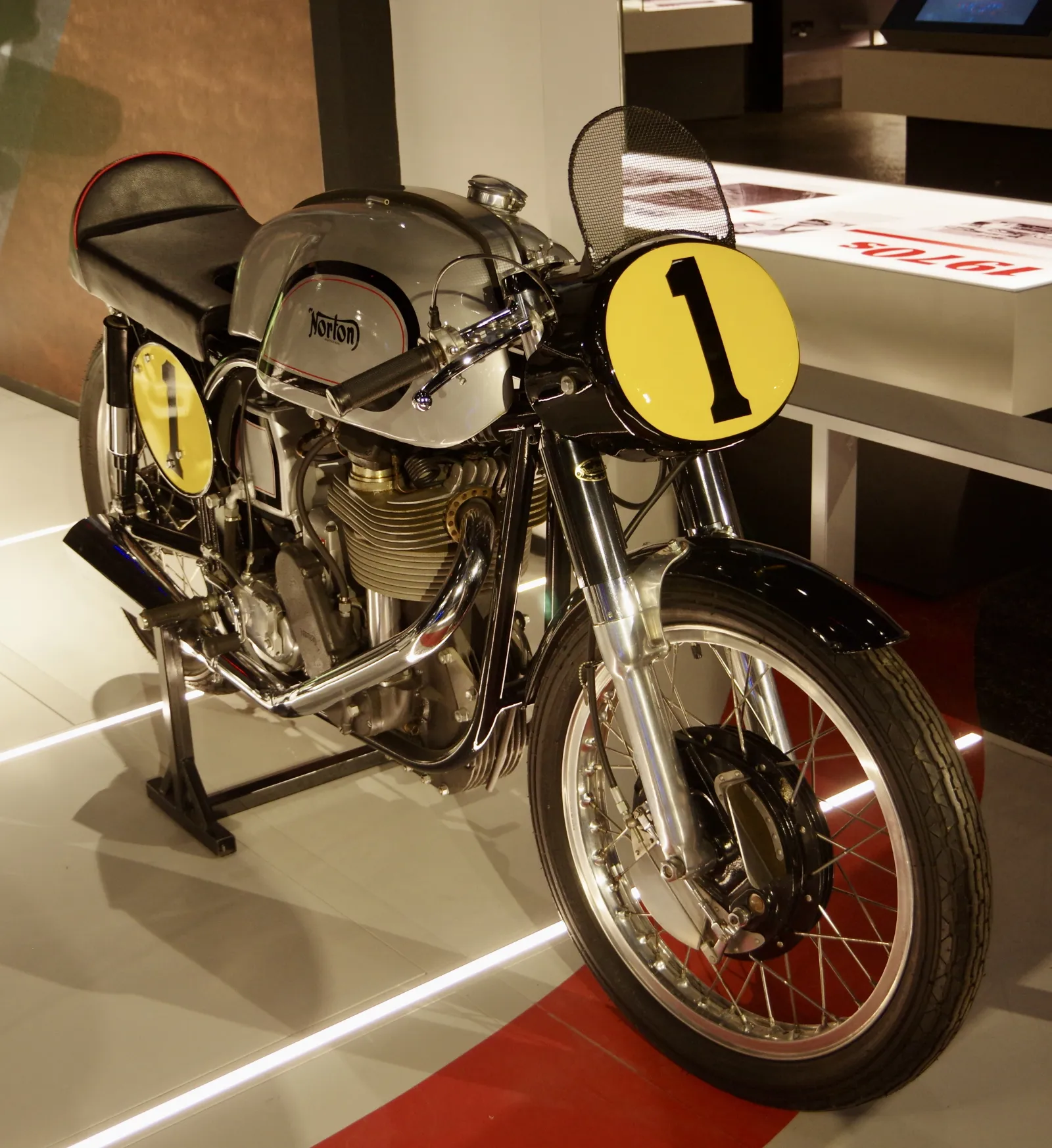
The Manx Norton is where racing motorcycle engineering reached its pre-Japanese zenith. The DOHC single — with its bevel-driven camshafts, meticulous porting, and ability to rev to places no pushrod engine could follow — was the benchmark racing engine from the late 1940s through the end of the single-cylinder era.
But the real legacy is below the engine. The Rex McCandless Featherbed frame, introduced in 1950, was so superior to everything else on the grid that it fundamentally changed how motorcycle chassis were designed.
Every Japanese manufacturer studied it, copied it, and built their empires on its principles. Geoff Duke, John Surtees, Mike Hailwood — they all raced Manxes.
This isn't just a fast old motorcycle; it's the blueprint for every sporting motorcycle that followed.
Patina notes
A genuine Manx with honest patina is a museum piece that belongs in motion. The alloy tank and bodywork develop a deep, warm patina that no chemical aging can replicate — it takes decades of fuel splashes, hand polishing, and atmospheric exposure to earn that glow.
The Featherbed frame, painted in Norton's signature silver, shows age as hairline cracks in the paint and surface rust at the welds. The magnesium engine cases on some years oxidize with a distinctive white bloom.
Racing history leaves its own marks — stone chips on the lower frame rails, boot wear on the footrests, scuffed knee cutouts on the tank. The problem is that genuine Manxes are now so valuable that most surviving examples have been restored to concours condition, which means honest patina is rarer than the bike itself.
Ownership reality
Let's be clear about what you're getting into: the Manx Norton is a purpose-built racing motorcycle that was never intended for road use. There are no lights, no horn, no concessions to road legality on a genuine article.
The DOHC engine is a precision instrument that demands precision maintenance — bevel gear adjustment, valve clearances measured in thousandths, and oil changes measured in racing hours, not road miles.
Starting requires technique and fitness; the high-compression single kicks back hard enough to launch you over the handlebars if you get sloppy. Most owners run them at vintage racing events, which is the correct context for the machine.
The financial reality is equally intense: a genuine Manx is a six-figure purchase, and engine rebuilds from specialists like Summerfield or Molnar run into five figures. This is not a hobby for the budget-conscious.
The verdict
Buy if
You want to own the single most important racing motorcycle in British history and you have the budget to maintain it properly. You're active in vintage racing or you're building a collection where provenance and engineering significance matter more than riding convenience. You understand that a Manx isn't an investment — it's a responsibility to preserve a machine that literally shaped the future of motorcycle design.
Skip if
You want something to ride on the road. You think $50,000 buys you a finished project. You're not prepared for the ongoing cost of specialist maintenance on a DOHC bevel-drive racing single. And critically — you need to be absolutely certain what you're buying is real. The Manx replica industry is vast and sophisticated, from faithful Molnar recreations (which are honest and excellent) to outright fakes with forged numbers. If you can't tell the difference or don't have access to someone who can, you're gambling at the wrong table.
What to look for
- → Frame and engine number verification through the Norton Owners Club registry — this is non-negotiable
- → Featherbed frame integrity — check for crash damage, especially at the steering head and swingarm pivot
- → DOHC bevel tower condition — worn bevels are expensive and there's no shortcut
- → Correct period camshaft and crankshaft — later upgrades are common and affect originality
- → Distinguish genuine Manx from Molnar, Summerfield, or other quality replicas (not necessarily a bad thing, but priced accordingly)
- → Magnesium case condition — corrosion can be structural, not just cosmetic
- → Racing history documentation — provenance adds significant value
- → Conical hub brake condition — these are powerful but need proper setup
Common problems
- ⚠ Bevel gear wear — the DOHC drive train is the most maintenance-intensive part of the engine and rebuilds require specialist knowledge
- ⚠ Crankshaft main bearing failure — the single's inherent vibration loads these hard
- ⚠ Magneto deterioration — the racing magneto needs periodic professional rebuild
- ⚠ Valve seat recession without hardened inserts — mandatory conversion for unleaded fuel
- ⚠ Oil scavenging issues — dry sump system relies on proper pump function and hose condition
- ⚠ Gearbox selector fork wear — vintage racing accelerates this
- ⚠ Frame cracking at the steering head under racing loads
Parts & community
Parts sources
- Andover Norton (UK) — the primary source for Norton parts worldwide
- RGM Motors (UK) — Norton specialist with Manx expertise
- Molnar Precision (Australia) — Manx replicas and precision engine components
- Summerfield Engineering (UK) — Manx engine rebuilds and performance parts
- Fair Spares (Australia) — Norton racing parts specialist
- Central Wheel Components (UK) — wheel rebuilds and spoke sets
Forums & communities
- Norton Owners Club (nortonownersclub.org)
- Access Norton (accessnorton.com)
- British Bike Forum (britishbikeforum.co.uk)
- VMCC (Vintage Motor Cycle Club)
Sources
- Norton Owners Club — Manx Registry · 2026-02-28
- Mick Walker — Norton: The Complete Illustrated History · 2026-02-28
- Classic Racer Magazine — Manx Norton Guide · 2026-02-28
Specifications
| Engine | 498cc DOHC air-cooled single (also available as 348cc) |
| Power | 47 hp @ 7,200 rpm (500cc) |
| Torque | 34 lb-ft @ 5,800 rpm |
| Transmission | 4-speed Norton close-ratio |
| Drivetrain | Chain |
| Weight | 320 lbs (dry) |
| Wheelbase | 55.5 inches |
| Production | Approximately 4,000 units total (1947-1962, both 350 and 500) |
Notable Features
- • Featherbed duplex frame (from 1950)
- • DOHC bevel-driven camshafts
- • Alloy fuel tank
- • Conical front hub brake
- • Manx tail section
- • Megaphone exhaust
- • Girder or Roadholder forks depending on year
About Norton
The racing aristocrat of British motorcycles. Norton won more Isle of Man TTs than anyone.
View all Norton vehicles →Find one
Looking to buy? Search current and past listings on Bring a Trailer.
Search on Bring a Trailer →