Why this vehicle matters
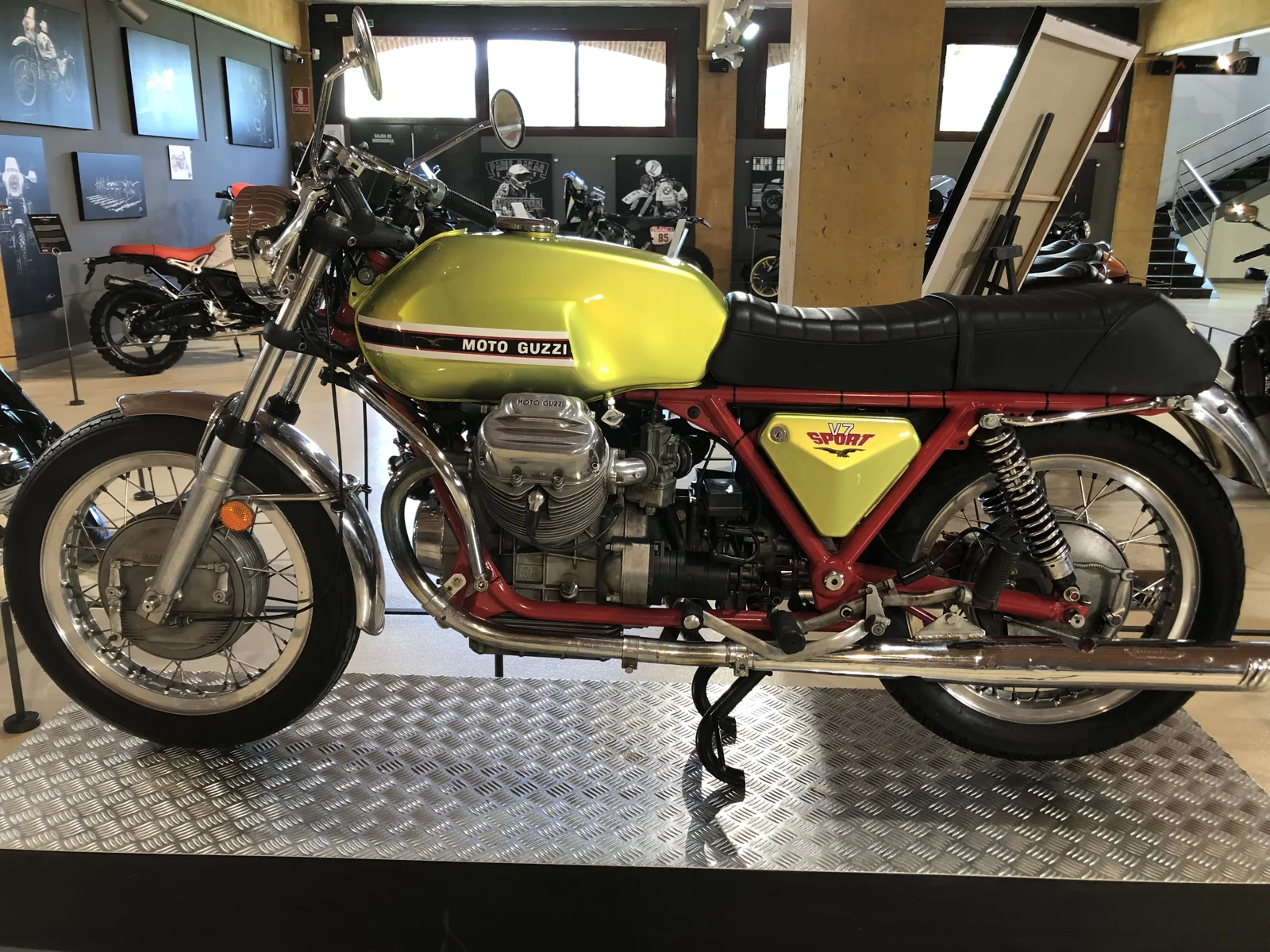
Moto Guzzi named it after the 24 Hours of Le Mans, and that tells you everything about their ambitions. The 850 Le Mans took the V7 Sport's chassis philosophy — low engine, communicative handling, shaft-drive directness — and gave it real muscle.
The 844cc engine with Dell'Orto pumper carbs made 71 horsepower, which doesn't sound like much until you remember that a contemporary Honda CB750F made 67 and weighed about the same.
The Le Mans was genuinely fast for 1976, and it handled with a precision that embarrassed bikes making twice the horsepower a decade later. The linked braking system was years ahead of its time — the same concept Honda would market as a revolution on the CBR1000 twenty years later.
Four series were produced over seventeen years, but the Mk I in red and black is the definitive version. It's the motorcycle that proved Italian engineering and Italian style could coexist in a package that was actually reliable enough to ride every day.
Patina notes
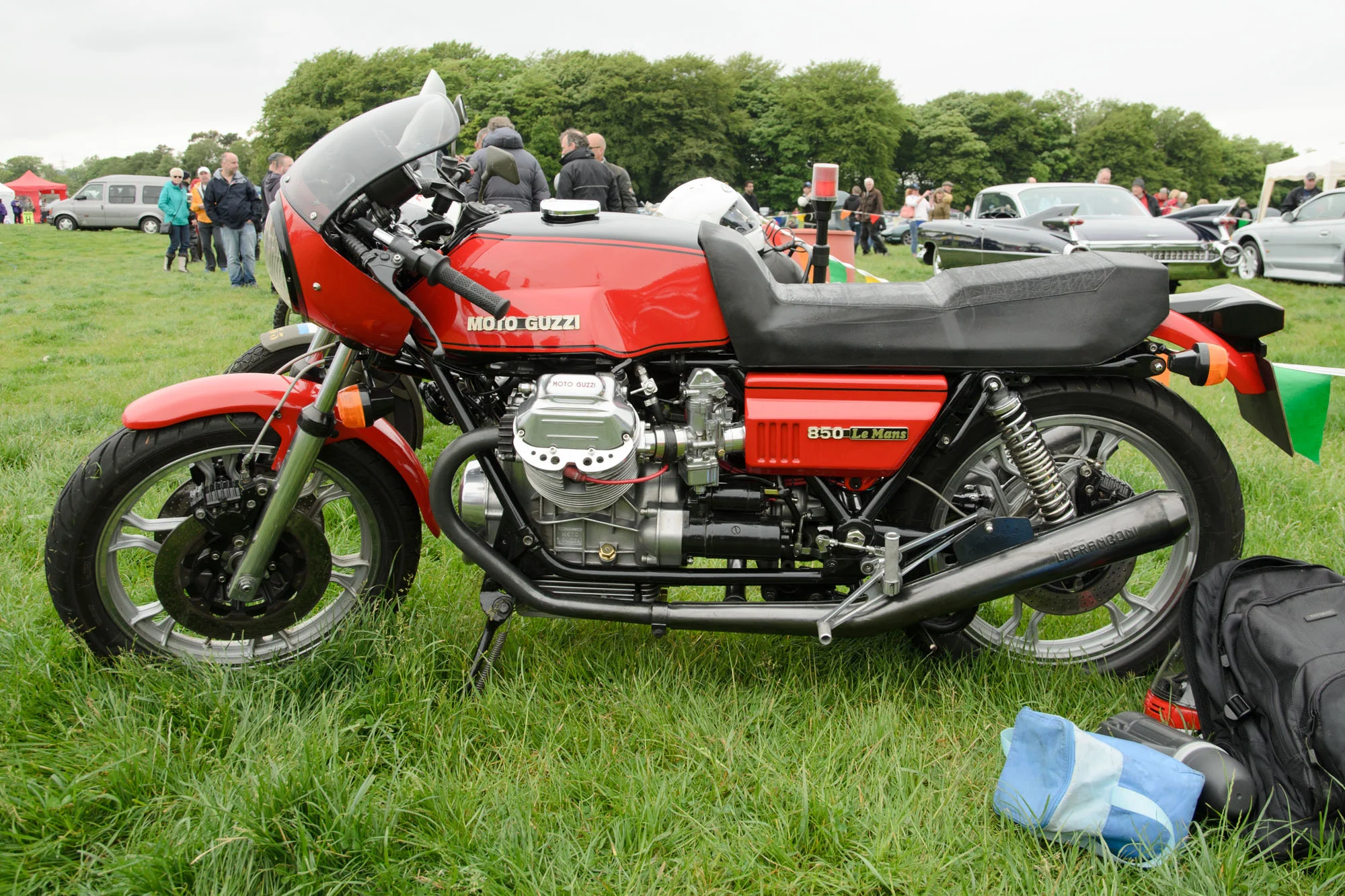
The Mk I Le Mans in red and black is one of those rare machines where the factory color scheme was so perfect that anything else feels like a compromise.
The red fades from fire-engine bright to a deeper, more burgundy tone over decades of sun exposure, which arguably looks better than fresh paint. The black lower panels and engine cases create a visual mass that grounds the bike.
The bikini fairing's plexiglass yellows slightly over time — don't replace it unless it's cracked, because the yellowed screen against the red fairing is exactly right.
The cast wheels oxidize to a chalky matte if neglected, but clean up beautifully with aluminum polish. The engine cases develop the same characterful oxidation as the V7 Sport, and the exposed pushrods and rocker covers collect a fine patina of road grime and oil mist that practically begs you to leave it alone. A clean Le Mans is a maintained Le Mans, not a detailed one.
Ownership reality
The Le Mans is the Moto Guzzi that actually works as a motorcycle, not just as a conversation piece. The 844cc engine has enough power to keep up with modern traffic without wringing its neck. The shaft drive means no chain maintenance.
The linked brakes, once understood, provide excellent stopping power with less effort than conventional setups. The engine is mechanically simple — pushrods, two valves per cylinder, cylinders hanging in the breeze for easy access.
Valve adjustments take thirty minutes. Oil changes are straightforward. The gearbox is better than the V7 Sport's, though 'better' is relative — it's still a Guzzi box, and it still prefers deliberate inputs over speed-shifting.
The Le Mans will genuinely tour — it's comfortable enough for 200-mile days, the tank range is good, and the shaft drive makes it a low-maintenance distance machine. Fuel consumption is reasonable for an 850cc twin.
The community is passionate and generous with knowledge, and MG Cycle's parts catalog means you're never really stuck. This is the vintage Italian motorcycle you can use as actual transportation.
The verdict
Buy if
You want the most usable classic Italian motorcycle money can buy. The Le Mans delivers the Guzzi V-twin experience — that torque reaction, that exhaust note, that mechanical connection — in a package that's genuinely comfortable, adequately fast, and maintainable without a specialist. The Mk I is the collector's choice, but Mk II and III bikes are significantly cheaper and mechanically nearly identical. If you want to actually ride an Italian classic instead of just owning one, this is the answer.
Skip if
You're fixated on the Mk I specifically and can't stomach the premium over later series. The Mk I commands a significant price advantage because of its looks, but a Mk III Le Mans is the same motorcycle in different clothes for half the money. Skip the Le Mans entirely if you can't live with the shaft drive's torque reaction in corners — some riders never acclimate to the bike rising and falling on throttle inputs, and that's a fundamental characteristic, not a defect. Also skip if you weigh under 150 pounds — the linked braking system was calibrated for an average Italian male of the 1970s, and lighter riders sometimes find the pedal pressure requires real effort.
What to look for
- → Series identification — Mk I (1976-78) has the round tail light and angular tank; verify against Guzzi production records
- → Frame number and engine number matching — later engines were often swapped into earlier frames for a value bump
- → Linked brake hydraulics — check all three calipers for even piston movement, the proportioning valve is the system's weak point
- → Dell'Orto accelerator pump function — squeeze the throttle with the carbs off the engine and verify a clean squirt of fuel
- → Rear drive splines — pull the rear wheel and inspect, worn splines are a known Guzzi issue across all shaft-drive models
- → Steering head bearing condition — same loading pattern as the V7 Sport, check for notchiness
- → Alternator output — should hold 13.8-14.2V at idle with lights on, anything less indicates stator or regulator issues
Common problems
- ⚠ Rear drive spline wear — the single most important maintenance item on any shaft-drive Guzzi, grease every 10,000 miles minimum
- ⚠ Linked brake proportioning valve seizure — the valve corrodes internally if brake fluid isn't changed regularly, causing uneven braking
- ⚠ Starter motor gear engagement — the Bosch starter's Bendix drive wears, causing grinding on engagement
- ⚠ Voltage regulator failure — no warning symptoms, just sudden loss of charging, carry a spare
- ⚠ Clutch cable fraying inside the adjuster — unique to the Le Mans routing, inspect regularly
- ⚠ Exhaust crossover pipe corrosion — the crossover collects condensation and rusts from the inside out
- ⚠ Headlight switch melting — the original handlebar switch can't handle the current draw, upgrade the circuit with a relay
Parts & community
Parts sources
- MG Cycle (mgcycle.com) — the single best source for Moto Guzzi parts in the Americas, bar none
- Harper's Moto Guzzi (harpersmotoguzzi.com) — long-established Guzzi specialist dealer
- Stein-Dinse (Germany) — enormous European inventory, ships worldwide
- Gutsibits (UK) — strong Le Mans parts catalog with reasonable international shipping
- Todd's Cycle (Arizona) — Guzzi specialist with fabrication capability for unobtainable parts
Forums & communities
- Wildguzzi (wildguzzi.com) — the forum for Moto Guzzi, with deep Le Mans-specific threads
- Moto Guzzi National Owners Club (mgnoc.com) — organized rides, tech days, and classifieds
- Guzzi Tech (guzzitechforum.com) — technically focused discussion
- Le Mans Register — model-specific community tracking surviving Mk I examples
Sources
- Mick Walker — Moto Guzzi V-Twins: The Complete Story · 2026-02-28
- Motorcycle Classics — Moto Guzzi 850 Le Mans Mk I · 2026-02-28
- Wildguzzi Le Mans Technical Archive · 2026-02-28
- Ian Falloon — Moto Guzzi Big Twins · 2026-02-28
Specifications
| Engine | 844cc air-cooled OHV 90-degree transverse V-twin |
| Power | 71 hp @ 7,300 rpm |
| Torque | 52 lb-ft @ 5,800 rpm |
| Transmission | 5-speed |
| Drivetrain | Shaft |
| Weight | 475 lbs |
| Wheelbase | 58.3 inches |
| Production | Approximately 6,400 Mk I units (1976-1978); ~24,000 across all four series (1976-1993) |
Notable Features
- • Bikini fairing with integrated instruments
- • Linked braking system — pedal activates rear and one front disc
- • Dell'Orto PHF 36mm pumper carburetors with accelerator pumps
- • Tonti duplex cradle frame
- • Cast alloy wheels (Mk I)
- • Red/black factory livery
About Moto Guzzi
The other Italian motorcycle company. Transverse V-twins, shaft drive, and a cult following that rivals any religion.
View all Moto Guzzi vehicles →Find one
Looking to buy? Search current and past listings on Bring a Trailer.
Search on Bring a Trailer →