Why this vehicle matters
Lino Tonti was given one job: make the agricultural V7 engine into a sportbike. What he delivered was a motorcycle that handled differently from everything else on the road — and still does.
The transverse V-twin layout means the crankshaft sits longitudinally, and when you crack the throttle mid-corner, the entire motorcycle reacts. The shaft drive torque lifts one side and drops the other. It sounds like a defect on paper.
In practice, once you learn it, the Guzzi communicates more information about traction and lean angle through your seat and pegs than any other motorcycle of the era.
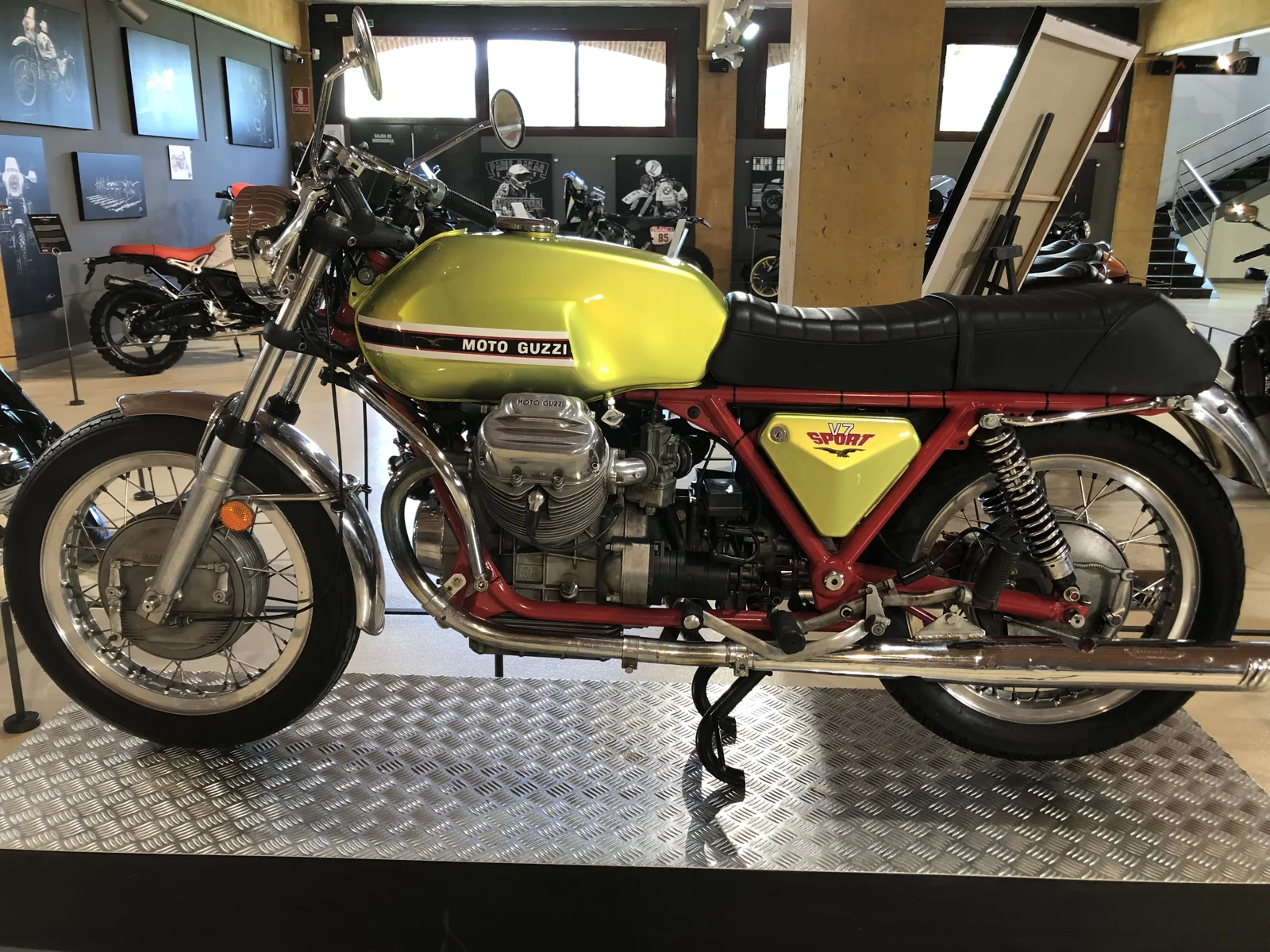
Tonti's frame dropped the engine low and forward, creating a center of gravity that made contemporary sportbikes feel top-heavy. Only about 4,000 were made, and the green-frame bikes — the telaio rosso cars had red, but these had green — are among the most sought-after Italian motorcycles of the 1970s.
The V7 Sport proved that Moto Guzzi wasn't just a touring bike company with a racing history — they could still build something that made your palms sweat.
Patina notes
The green frame is the V7 Sport's signature, and it ages magnificently. The original Mandello green develops a depth over decades that fresh paint can't replicate — it darkens in the crevices and stays bright on the exposed surfaces, creating a natural two-tone effect.
The red tank paint on original bikes develops a fine crazing pattern that catches light like old lacquer. The engine cases, being a softer alloy than Japanese or German castings, oxidize to an uneven matte gray that gives the motor a handmade quality — because it essentially was.
The Veglia instruments develop the same parchment-cracking as Ducati gauges of the era. The chrome exhaust crossover pipe discolors unevenly because of the different header temperatures, creating an asymmetrical patina that looks intentional.
A V7 Sport with original paint and forty years of careful use is one of the most photogenic motorcycles in existence.
Ownership reality
Owning a V7 Sport is like owning a vintage Italian sports car that weighs 460 pounds instead of 2,400 — you get all the character, all the mechanical intimacy, and all the quirks, but you can push it home when something goes wrong.
The engine is fundamentally simple: two big cylinders sticking out in the wind, pushrods, two valves per cylinder, nothing to confuse. Valve adjustments are easy with the cylinders exposed. The shaft drive eliminates chain maintenance.
The linked braking system takes some learning — the rear pedal activates the rear brake and one front disc, the hand lever activates the other front disc — but once internalized, it's actually brilliant.
The gearbox is the weak point: the shift linkage is vague, and finding neutral requires the delicacy of a safecracker. Parts availability has improved dramatically thanks to dedicated specialists, but you're still dealing with a low-production Italian motorcycle from the 1970s.
Budget for surprises, cultivate relationships with suppliers, and join the Wildguzzi forum before you buy — the collective knowledge there will save you thousands.
The verdict
Buy if
You want a motorcycle that offers a riding experience genuinely unavailable from any other manufacturer. The transverse V-twin's torque reaction, the shaft drive's mechanical directness, the way the whole motorcycle communicates through the chassis — nothing else feels like a Guzzi. You appreciate engineering that prioritized dynamic behavior over raw power, and you're drawn to the idea of a motorcycle designed by a single engineer with a singular vision. The V7 Sport is Tonti's thesis statement, and it's still being argued over fifty years later.
Skip if
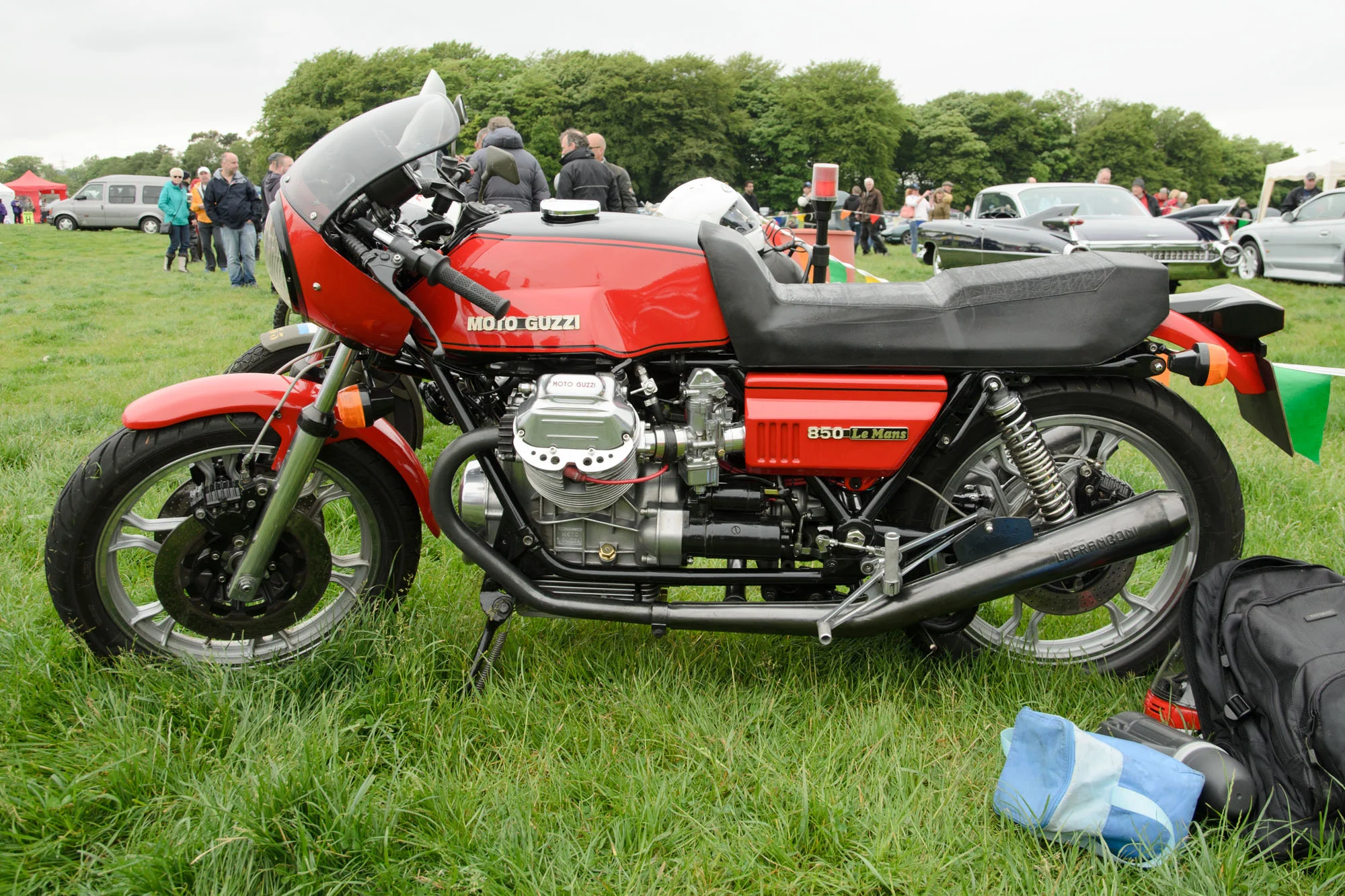
You want a motorcycle that shifts cleanly. The V7 Sport's gearbox is its Achilles heel, and no amount of adjustment fully cures the vagueness. Skip if Italian parts sourcing and shipping times give you anxiety. Also skip if you're a collector looking for a garage queen — these bikes are too rare and too good to not ride, and the community will quietly judge you if yours never leaves the paddock stand. If you want the Guzzi V-twin experience without the collector premium, the 850 Le Mans is more attainable and nearly as special.
What to look for
- → Frame color and number — the original green-frame bikes are most desirable, verify the frame stamp matches Guzzi records
- → Engine number matching — replacement engines from V7 Special or Ambassador models are physically identical but change the bike's provenance
- → Gearbox engagement — ride through all five gears, check for false neutrals and hard shifts, especially 1st to 2nd
- → Shaft drive U-joint condition — clunk on throttle transitions indicates wear
- → Brembo brake calipers — early triple-disc setup should have matching calipers, check for seized pistons
- → Rear suspension linkage — the unique Tonti frame has specific mounting points that crack under stress
- → Steering head bearings — the low-mounted engine puts unusual loads here, check for notchy turning
Common problems
- ⚠ Gearbox shift mechanism wear — the linkage develops slop, and the internal selector forks wear, making precise shifts difficult
- ⚠ Generator output marginal — the Bosch unit barely keeps up with stock electrics and has no headroom for accessories
- ⚠ Clutch judder when cold — the single-plate dry clutch needs warming before smooth engagement
- ⚠ Shaft drive spline wear — the rear drive splines need regular greasing, neglect leads to expensive replacement
- ⚠ Carb synchronization drift — the Dell'Orto VHB carburetors need balancing more often than you'd expect
- ⚠ Voltage regulator failure — carries no warning, just a dead battery and no spark
Parts & community
Parts sources
- MG Cycle (mgcycle.com) — the definitive American source for Moto Guzzi parts, run by enthusiasts
- Harper's Moto Guzzi (harpersmotoguzzi.com) — long-standing Guzzi specialist
- Stein-Dinse (Germany) — European source with deep NOS inventory
- Moto Guzzi Classics (Netherlands) — specialist in pre-1980 Guzzi parts
- Agostini (Mandello del Lario) — factory-adjacent parts source in Guzzi's hometown
Forums & communities
- Wildguzzi (wildguzzi.com) — the central hub for all things Moto Guzzi, extremely knowledgeable community
- Moto Guzzi National Owners Club (mgnoc.com)
- Guzzi Tech (guzzitechforum.com) — technically focused Guzzi discussion
- ADVRider (advrider.com) — active Guzzi section within the larger forum
Sources
- Mick Walker — Moto Guzzi V-Twins: The Complete Story · 2026-02-28
- Motorcycle Classics — Moto Guzzi V7 Sport · 2026-02-28
- Wildguzzi Technical Archive · 2026-02-28
Specifications
| Engine | 748cc air-cooled OHV 90-degree transverse V-twin |
| Power | 52 hp @ 6,300 rpm |
| Torque | 44 lb-ft @ 5,000 rpm |
| Transmission | 5-speed |
| Drivetrain | Shaft |
| Weight | 460 lbs |
| Wheelbase | 57.7 inches |
| Production | Approximately 4,000 units (1971-1974) |
Notable Features
- • De Tomaso low-slung duplex cradle frame designed by Lino Tonti
- • Engine canted forward for lower center of gravity
- • Shaft drive with reactive torque in corners
- • Triple Brembo disc brakes (early adopter)
- • Rear-set footpegs
- • Iconic green frame with red tank livery
About Moto Guzzi
The other Italian motorcycle company. Transverse V-twins, shaft drive, and a cult following that rivals any religion.
View all Moto Guzzi vehicles →Find one
Looking to buy? Search current and past listings on Bring a Trailer.
Search on Bring a Trailer →