Why this vehicle matters
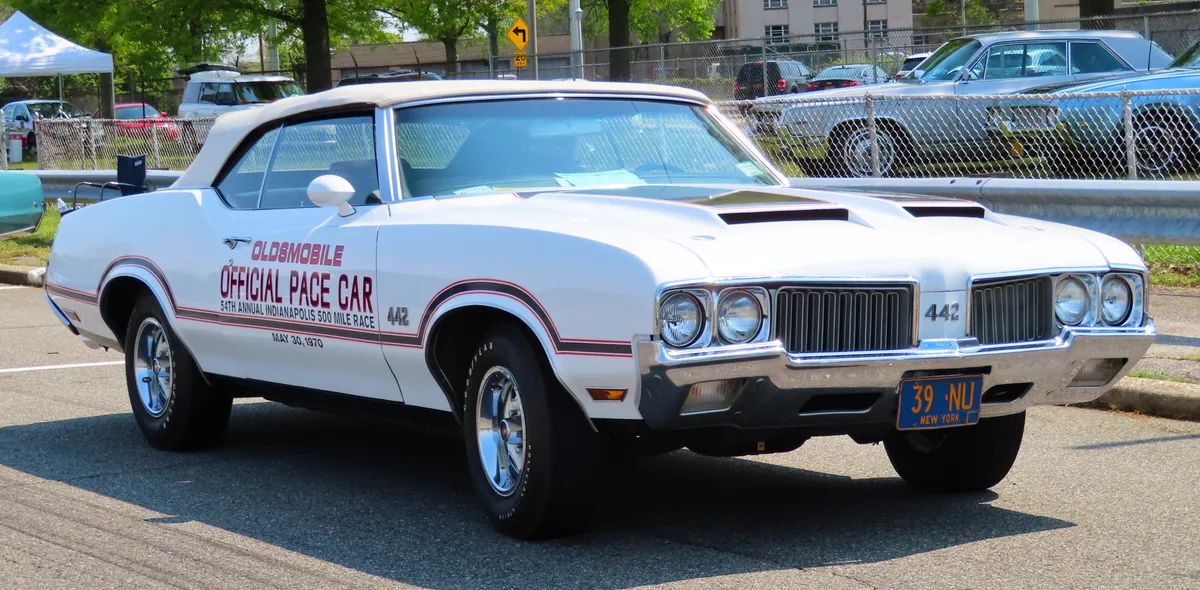
The 442 was Oldsmobile's answer to the GTO, and by 1970 it had evolved into a legitimate muscle car heavyweight. The 455 V8 made a stump-pulling 500 lb-ft of torque.
The W-30 package added Ram Air induction, a hotter cam, and an aluminum intake — the fastest Oldsmobile you could buy. The '70 redesign gave it swoopier lines that aged better than some competitors. 'Dr.
Oldsmobile' ads positioned it as the prescription for boring transportation. The 442 name originally meant 4-barrel carb, 4-speed manual, and dual exhaust — by 1970 it had become its own model designation.
Patina notes
The 1970 body style holds up well with honest wear. The chrome and trim can develop character. The '70 specific details (hood, grille, taillights) are distinct from '69 and '71, so correct parts matter.
Original W-30 cars are significantly more valuable than clones, but well-executed tributes have their place. The plastic 'Rallye' wheels were cool in period but reproduce well now.
Ownership reality
Oldsmobile muscle is finally getting respect after decades of living in the shadow of Chevys and Pontiacs. Parts availability is decent — not as good as a Chevelle, but workable. The 455 is a bulletproof engine with massive low-end torque.
These cars are comfortable cruisers that happen to make serious power. The Oldsmobile community is smaller but dedicated, and documentation through PHS (Pontiac-Oldsmobile-Buick documentation) is available.
The verdict
Buy if
You want muscle car presence without the Camaro/Mustang crowds. You appreciate torque over horsepower. You like being the knowledgeable one at the car show.
Skip if
You need the biggest parts support network. You want maximum investment appreciation (though Olds is catching up). You can't appreciate a GM brand that no longer exists.
What to look for
- → W-30 package documentation (PHS)
- → Frame and subframe rust
- → Quarter panel rust behind wheels
- → Trunk floor and taillight panel
- → Correct engine date codes for claimed package
- → Transmission and rear axle codes
Common problems
- ⚠ Frame rust in northern cars
- ⚠ 455 engines can develop oil leaks
- ⚠ Rear main seal is a common leak point
- ⚠ Power steering pump whine
- ⚠ Reproduction parts quality varies
- ⚠ Incorrect restorations are common
Parts & community
Parts sources
- OPGI (Original Parts Group)
- The Parts Place
- Year One
- Fusick Automotive Products (Olds specialist)
- Summit Racing
Forums & communities
- 442.com
- GarageJournal Oldsmobile section
- Pro-Touring.com
Sources
- Hagerty Valuation · 2026-02-04
- PHS Documentation · 2026-02-04
Specifications
| Engine | 455 cu in V8 (standard) / 455 W-30 V8 (option) |
| Power | 365 hp (standard) / 370 hp (W-30) |
| Torque | 500 lb-ft (standard) / 500 lb-ft (W-30) |
| Transmission | 3-speed auto / 4-speed manual |
| Drivetrain | RWD |
| Weight | 3,800 lbs |
| Wheelbase | 112 inches |
| Production | 19,330 (1970 hardtop coupes) |
Notable Features
- • 455 cubic inches of torque
- • W-30 performance package
- • Distinctive split grille
- • Dr. Oldsmobile advertising campaign
- • W-31 small-block option for insurance reasons
About Oldsmobile
GM's innovation lab. Automatic transmissions, Rocket V8s, front-wheel drive muscle — and then they killed it.
View all Oldsmobile vehicles →Find one
Looking to buy? Search current and past listings on Bring a Trailer.
Search on Bring a Trailer →