Why this vehicle matters
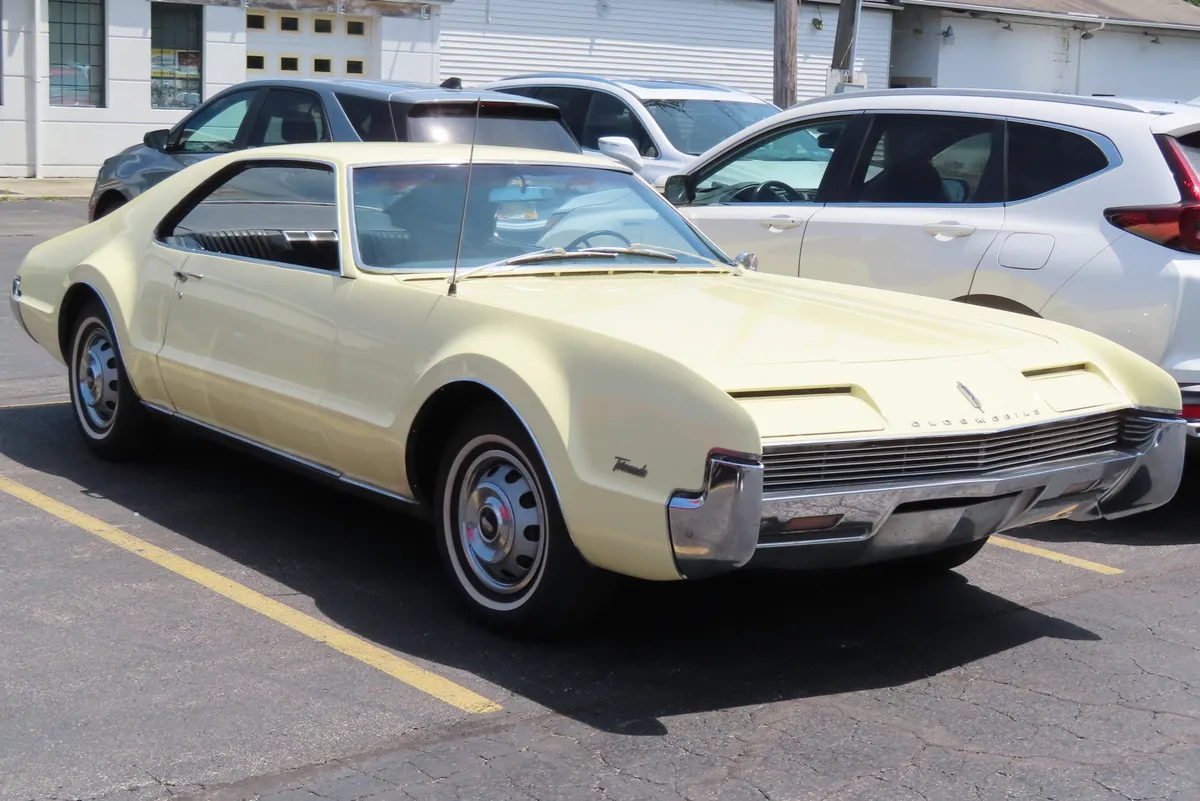
The Toronado was audacious: a full-size personal luxury car with front-wheel drive, at a time when the only other FWD cars in America were imports. GM's engineers developed a unique split drivetrain — the engine sits behind and above the transmission, connected by a chain to the torque converter.
It worked, and worked well enough to win Motor Trend's Car of the Year. The dramatic fastback roofline and hidden headlights made it look like nothing else on the road.
The Toronado proved that Oldsmobile was willing to take engineering risks that other GM divisions wouldn't touch.
Patina notes
The first-generation Toronado (1966-1967) is the collector's choice — the cleanest design before GM added bulk. The dramatic styling works well with patina; these cars look good honest and worn.
The unique FWD system means some components are Toronado-only, so preservation of original drivetrain parts matters.
Ownership reality
The Toronado's chain-drive FWD system is actually reliable, but it requires specialized knowledge for service. Finding a mechanic who understands it may take effort. The 425 Rocket V8 is a proven engine with good parts support.
The car drives like a modern FWD — planted through corners, less dramatic oversteer than RWD alternatives. Underrated as a driver compared to its contemporaries.
The verdict
Buy if
You appreciate engineering innovation. You want a genuine conversation piece. You like the personal luxury coupe format.
Skip if
You want a simple restoration. You need extensive parts interchange with other GMs. You're not interested in explaining FWD to everyone.
What to look for
- → Chain drive system condition
- → Transmission (unique to Toronado)
- → Front subframe rust
- → Hidden headlight mechanism
- → Frame rail rust at front
- → CV joint and hub condition
Common problems
- ⚠ Chain drive system adjustment
- ⚠ CV joint wear (high-stress application)
- ⚠ Transmission rebuild requires specialist
- ⚠ Hidden headlight vacuum motors
- ⚠ Unique parts scarcity for FWD system
- ⚠ Frame rust at suspension pickup points
Parts & community
Parts sources
- Fusick Automotive (Toronado specialist)
- OPGI (body and trim)
- The Parts Place
- Toronado.org classifieds
Forums & communities
- Toronado.org
- GarageJournal Oldsmobile section
- ClassicOldsmobile.com
Sources
- Hagerty Valuation · 2026-02-04
- Hemmings Motor News · 2026-02-04
Specifications
| Engine | 425 cu in Rocket V8 |
| Power | 385 hp |
| Torque | 475 lb-ft |
| Transmission | Turbo Hydra-Matic 400 (modified for FWD) |
| Drivetrain | FWD |
| Weight | 4,366 lbs |
| Wheelbase | 119 inches |
| Production | 40,963 (1966) |
Notable Features
- • First American front-wheel drive car since 1937
- • Hidden headlights
- • Full-width taillights
- • Split grille design
- • Unique chain-driven torque converter
About Oldsmobile
GM's innovation lab. Automatic transmissions, Rocket V8s, front-wheel drive muscle — and then they killed it.
View all Oldsmobile vehicles →Find one
Looking to buy? Search current and past listings on Bring a Trailer.
Search on Bring a Trailer →