Why this vehicle matters
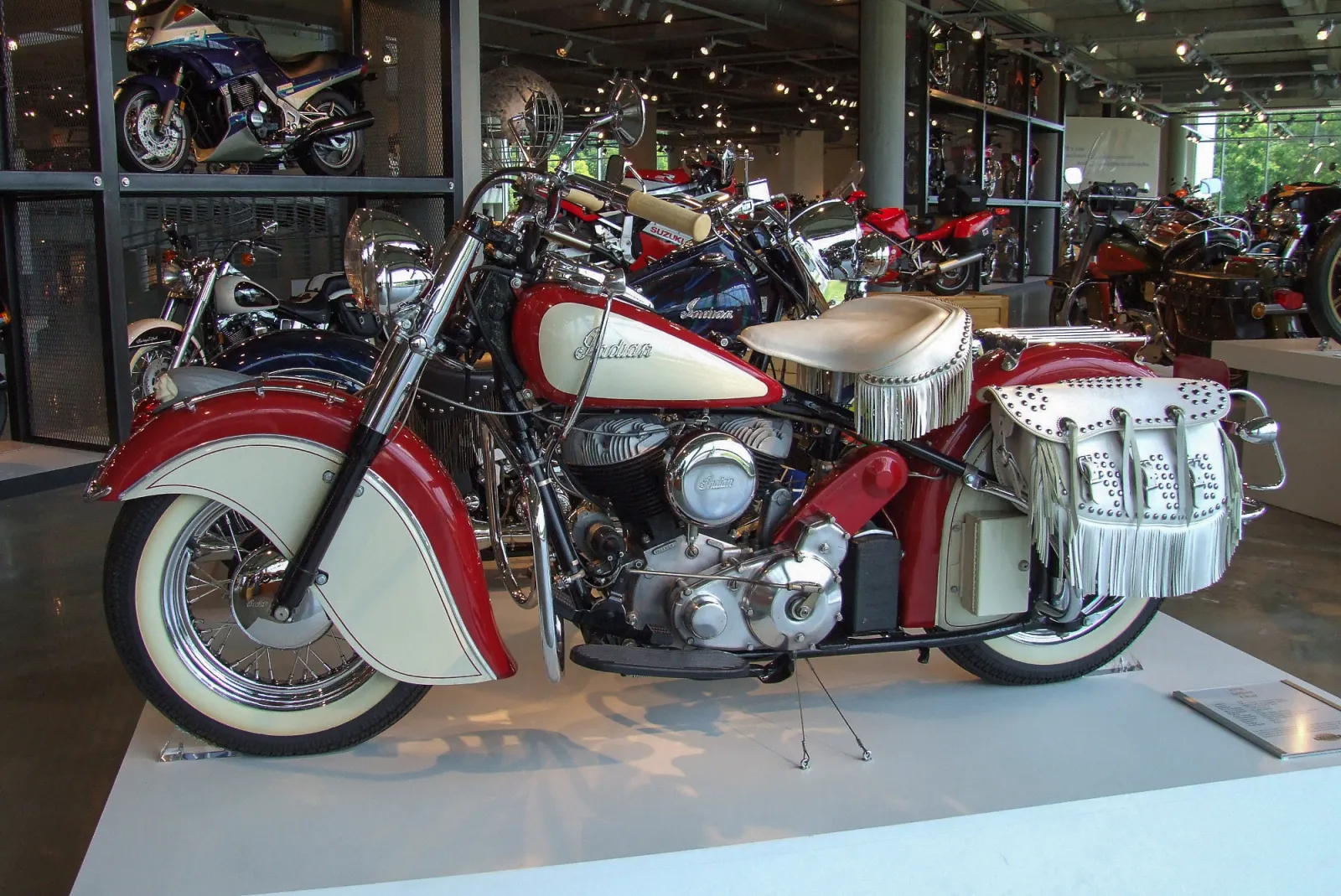
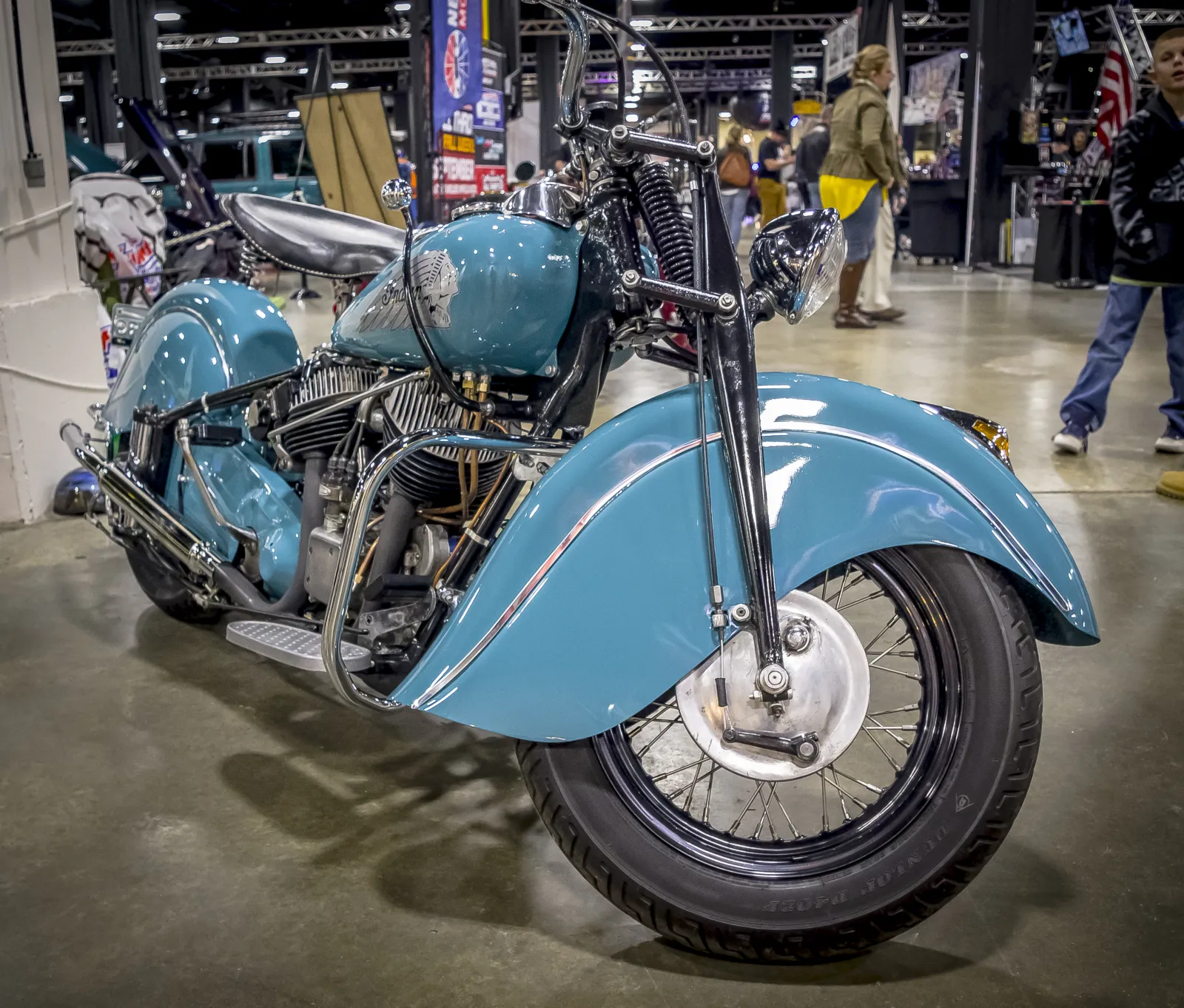
The Indian Chief is the most beautiful American motorcycle ever made, and that's not nostalgia talking — it's geometry. Those full-skirted fenders create a profile that nothing before or since has matched.
The post-war Chiefs represent Indian at its artistic peak, even as the company was circling the drain financially. Springfield was outspending Harley on engineering but hemorrhaging money on everything else.
These bikes were rolling sculptures built by a dying company that refused to cut corners on aesthetics. Every Chief that survives is proof that sometimes the doomed make the most beautiful things.
Patina notes
Original paint in any condition adds enormous value — Indian used deep, rich colors (Chief Red, metallic blue, black) that age magnificently. The skirted fenders are the signature, and they dent easily; straight originals are gold.
Chrome was heavy and holds up well if it wasn't stored wet. The flathead engine develops a distinctive patina on the iron cylinders that purists love.
Unrestored, original-paint Chiefs command premiums over full restorations now — the market has shifted firmly toward preservation. A ratty-but-complete Chief is worth more than a concours restoration with incorrect parts.
Ownership reality
Owning an Indian Chief is more like curating a piece of art that happens to run. The hand shift / foot clutch takes real practice — this is not a twist-and-go motorcycle. You will stall it in traffic. You will miss shifts.
Eventually your left hand and right foot develop muscle memory and it becomes second nature, but the learning curve is steep and public. Parts are available but expensive, and sourcing correct pieces requires knowledge of year-to-year changes.
The flathead engine is mechanically simple but requires a specialist who understands Indian-specific quirks. Finding that specialist is the real challenge — there are maybe a few dozen people in the country who truly know post-war Indians.
The verdict
Buy if
You understand that this is a slow-riding art object, not a performance machine. You're willing to learn hand shift. You want to own something that stops people in their tracks — literally, strangers will walk up to you at every gas station. You appreciate that some things are worth preserving exactly as they are.
Skip if
You want to actually ride regularly in traffic. You're not comfortable with hand shift / foot clutch. You need a parts ecosystem that's deep and affordable. You think $40,000 should buy you something reliable. You want a motorcycle, not a responsibility.
What to look for
- → Skirted fender condition — dents, rust-through, and incorrect reproductions
- → Matching engine and frame numbers (VIN on steering head, engine number on left case)
- → Correct springer fork assembly — reproductions exist but fitment varies
- → Generator and magneto condition (expensive to rebuild)
- → Original tinwork (tank, fenders) vs. reproduction — magnets can help identify filler
- → Transmission shift mechanism wear — hand shift linkage is complex and often butchered
Common problems
- ⚠ Oil leaks from every gasket surface — flatheads were designed to seep, not seal
- ⚠ Electrical system is 6-volt and marginal — generator output barely keeps up
- ⚠ Clutch adjustment is critical and finicky — wrong adjustment makes hand shift impossible
- ⚠ Skirted fenders trap moisture and accelerate rust from the inside out
- ⚠ Finding a mechanic who actually knows Indians (not just Harleys) is the biggest challenge
Parts & community
Parts sources
- Kiwi Indian Parts (kiwi-indian.com) — the gold standard for reproduction parts
- Starklite Indian Motorcycles — NOS and reproduction
- Indian Motocycles parts on eBay — proceed with caution, lots of misidentified parts
Forums & communities
- Indian Motocycles Forum (indianmotocycles.net)
Sources
- Motorcycle Classics · 2026-02-28
- Bring a Trailer · 2026-02-28
Specifications
| Engine | 74ci (1200cc) flathead V-twin |
| Power | ~40 hp |
| Torque | ~50 lb-ft (estimated) |
| Transmission | 3-speed, hand shift |
| Drivetrain | Chain |
| Weight | 550 lbs (dry) |
| Wheelbase | 62 inches |
| Production | ~15,000 (1946-1953 Chiefs) |
Notable Features
- • Full-skirted fenders — the defining silhouette
- • Hand shift / foot clutch (suicide shift)
- • Springer front fork
- • Left-side throttle (pre-1952)
About Indian
America's first motorcycle company. Before Harley was a household name, Indian was already winning races.
View all Indian vehicles →Find one
Looking to buy? Search current and past listings on Bring a Trailer.
Search on Bring a Trailer →