Why this vehicle matters
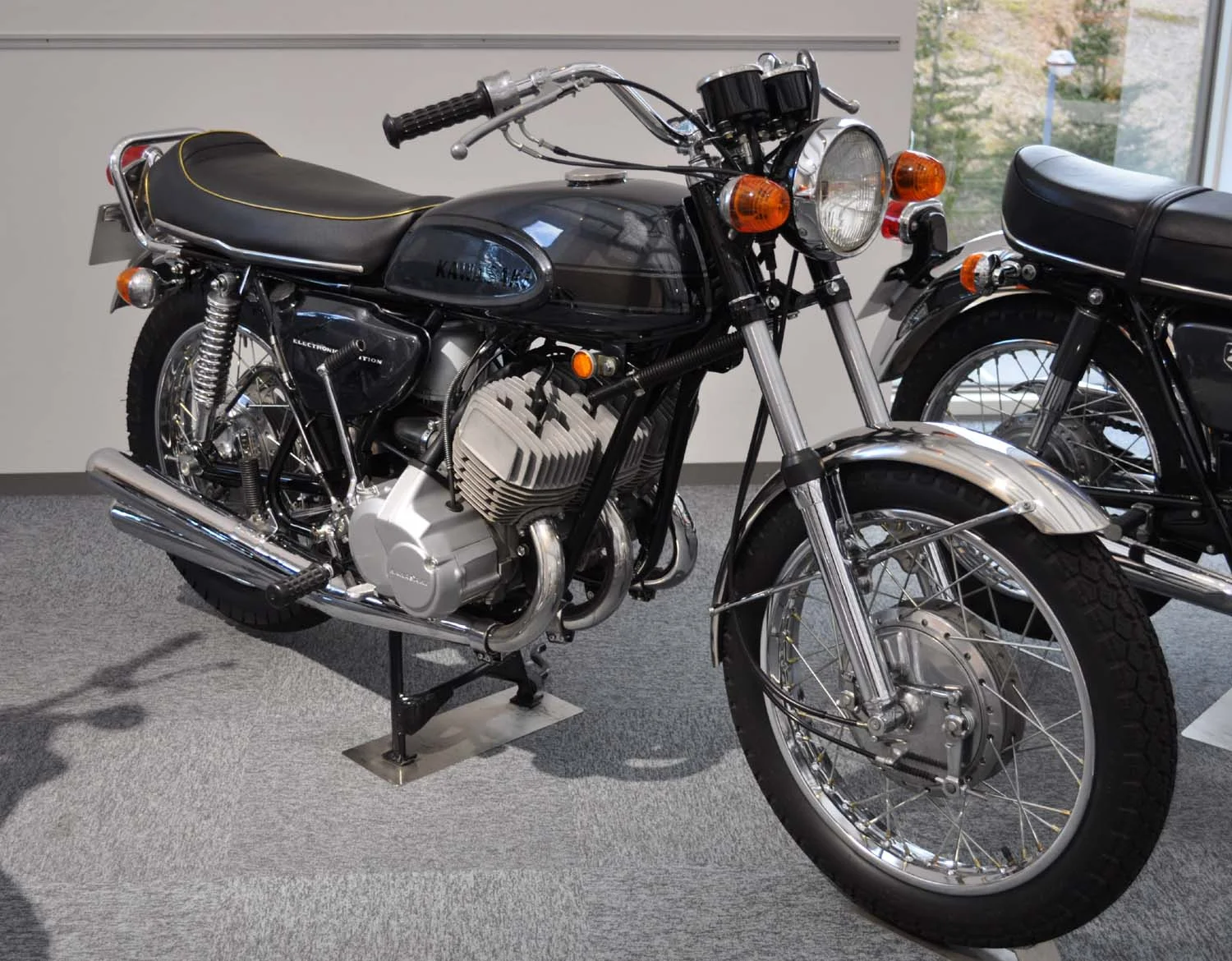
The Kawasaki H1 Mach III earned the name 'Widowmaker' honestly. Sixty horsepower doesn't sound like much until you remember it came from a two-stroke engine in a 385-pound chassis with drum brakes and the frame rigidity of a garden gate.
The power hit like a light switch — nothing, nothing, nothing, then all 60 horsepower at once. The front wheel came up in every gear. The handling was atrocious. The brakes were suggestions. And people absolutely loved it.
The H1 was Kawasaki's reputation-maker, establishing the brand as the one that built motorcycles your mother specifically told you not to buy. Every liter-bike with too much power and not enough chassis owes something to the Mach III.
Patina notes
Two-strokes show their miles differently. The exhaust staining is heavier and more persistent — those three expansion chambers develop a baked-on oil residue that's part of the character. The air-cooled cylinders show heat discoloration.
Paint on early models tends toward metallics and bright colors that fade dramatically under sun exposure. The chrome fenders pit but the steel underneath is usually solid.
Two-stroke residue gets everywhere — accept it as part of the ownership aesthetic. A clean H1 is suspicious; a slightly oily one with road rash is authentic.
Ownership reality
Owning an H1 means owning a two-stroke, which means pre-mix oil (or an oil injection system you need to trust), plug fouling, and the constant aroma of burning two-stroke oil.
The engine needs to be ridden hard to stay happy — lugging a two-stroke kills it. Parts are available but increasingly expensive. The triple engine is mechanically simpler than a four-stroke (no valves, no cam chains) but the ignition timing and carburetor synchronization across three cylinders demands attention.
Riding one in modern traffic requires commitment — the power delivery is not progressive, the handling rewards smooth inputs only, and the brakes require planning. This is not a beginner bike in any sense of the word.
The verdict
Buy if
You want the most visceral, terrifying motorcycle experience the 1970s produced. You understand two-stroke maintenance and enjoy the ritual. You want a piece of Kawasaki's dangerous DNA before they went respectable with the Z1.
Skip if
You've never owned a two-stroke motorcycle (start with something less lethal). You want a comfortable cruiser. You prefer your motorcycles predictable. You're bothered by oil on your garage floor.
What to look for
- → Cylinder bore condition (score marks from seizure indicate abuse)
- → Crankshaft seal integrity (air leaks cause lean running and seizure)
- → CDI ignition system function (test at all RPM ranges)
- → Frame cracks at steering head and swingarm pivot (flex-prone chassis)
- → Three-into-three exhaust condition (expansion chambers rust from inside out)
- → Oil injection pump function (if equipped — many converted to premix)
Common problems
- ⚠ Crankshaft seal failures (causes air leaks and potential seizure)
- ⚠ Piston seizure from lean running (two-stroke's mortal enemy)
- ⚠ Expansion chamber exhaust rot (rusts from condensation inside)
- ⚠ CDI ignition box failures
- ⚠ Frame flex under hard acceleration (by design, unfortunately)
- ⚠ Carburetor synchronization drift across three cylinders
Parts & community
Parts sources
- Z1 Enterprises (Kawasaki specialist)
- eBay (NOS parts still surface regularly)
- Kawasaki Triple Shop
- CMSNL.com (Dutch — massive Kawasaki parts catalog)
- Two-stroke specialists (regional — ask the forums)
Forums & communities
- KawasakiTriples.com
- KZRider.com
- Kawasaki H1/H2 Facebook groups
- Reddit r/vintagemotorcycles
Sources
- Bring a Trailer · 2026-02-28
- Motorcycle Classics · 2026-02-28
Specifications
| Engine | 498cc air-cooled two-stroke triple |
| Power | 60 hp @ 7,500 rpm |
| Torque | 38 lb-ft @ 7,000 rpm |
| Transmission | 5-speed |
| Drivetrain | Chain |
| Weight | 385 lbs dry |
| Wheelbase | 56 inches |
| Production | High volume, 1969-1975 |
Notable Features
- • Two-stroke triple cylinder (screaming power delivery)
- • Capacitor discharge ignition (CDI)
- • Front wheel lifts in every gear from factory
- • Three expansion-chamber exhausts
About Kawasaki
The heavy industry giant that decided motorcycles should be terrifying. They weren't wrong.
View all Kawasaki vehicles →Find one
Looking to buy? Search current and past listings on Bring a Trailer.
Search on Bring a Trailer →