Why this vehicle matters
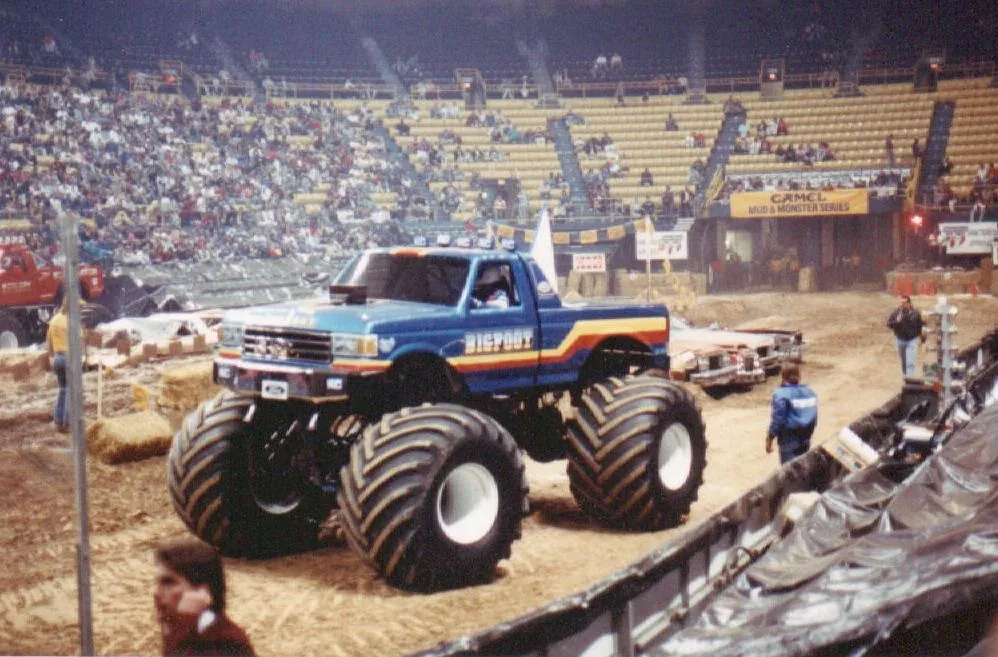
Every monster truck show, every Grave Digger, every Monster Jam — they all trace back to one guy and his Ford F-250. Bob Chandler was a construction contractor in St.
Louis who kept breaking parts on his truck and replacing them with bigger, stronger components. By 1979, the truck had 48-inch tires and the Bigfoot name. In 1981, a promoter asked if the truck could drive over some junk cars. It could.
The crowd went insane. Chandler realized he'd stumbled onto something. Within years, monster truck shows were selling out arenas across America. Bigfoot didn't just create a vehicle — it created a spectator sport.
And the name? Absolutely perfect. 'Bigfoot' captures everything: the massive tires, the legendary mystique, the sense that you're witnessing something that shouldn't exist.
Chandler wasn't just a fabricator — he was a marketer who understood that a truck crushing cars needed a name that lived in the imagination. Sasquatch-level branding for a sasquatch-level machine.
Patina notes
The original Bigfoot (Bigfoot 1) is preserved and still makes occasional appearances. It's not for sale — it's a piece of American motorsport history. Later Bigfoot trucks (numbered 2-21+) are purpose-built show vehicles.
If you want a monster truck, you build one or buy a retired show vehicle. You don't buy 'a Bigfoot.'
Ownership reality
You don't own a Bigfoot. You can build a monster truck using similar principles — start with a solid-axle truck, add a massive suspension lift, swap to agricultural or construction tires, reinforce everything.
But the original Bigfoot trucks belong to Bigfoot 4×4, Inc. Monster truck ownership is an obsession: custom fabrication, constant maintenance, transportation logistics, and a yard that can handle a 10,000-lb vehicle with 66-inch tires.
The verdict
Buy if
You can't. But you can attend a monster truck show and understand why a modified Ford F-250 from St. Louis changed automotive entertainment forever.
Skip if
You think monster trucks are just entertainment. They are, but they're also engineering achievements and the foundation of a billion-dollar industry.
What to look for
- → N/A — original trucks are museum pieces
- → For building your own: solid-axle donor truck
- → Massive suspension and tire clearance
- → Reinforced frame and drivetrain
- → Rollover protection
Common problems
- ⚠ Everything breaks under monster truck stress
- ⚠ Tires are expensive and wear quickly
- ⚠ Transportation requires a trailer
- ⚠ Insurance is complicated
- ⚠ Neighbors hate you
Parts & community
Parts sources
- Bigfoot 4×4 (official)
- Monster truck fabrication shops
- Agricultural tire suppliers
- Custom suspension builders
Forums & communities
- MonsterMayhem.org
- Monster Truck Forums
- Bigfoot 4×4 official Facebook
Sources
- Bigfoot 4×4 Official History · 2026-02-04
Specifications
| Engine | 460 cu in (7.5L) Ford V8 (varies by iteration) |
| Power | 640+ hp (current versions) |
| Torque | Massive |
| Transmission | Custom |
| Drivetrain | 4WD |
| Weight | 10,000+ lbs |
| Wheelbase | Custom |
| Production | 21+ trucks (Bigfoot 1-21) |
Notable Features
- • 66-inch tires (original had 48-inch)
- • First monster truck
- • First vehicle to crush cars (1981)
- • Created an entire motorsport category
- • Based on 1974 Ford F-250
About Bigfoot
View all Bigfoot vehicles →Find one
Looking to buy? Search current and past listings on Bring a Trailer.
Search on Bring a Trailer →