Why this vehicle matters
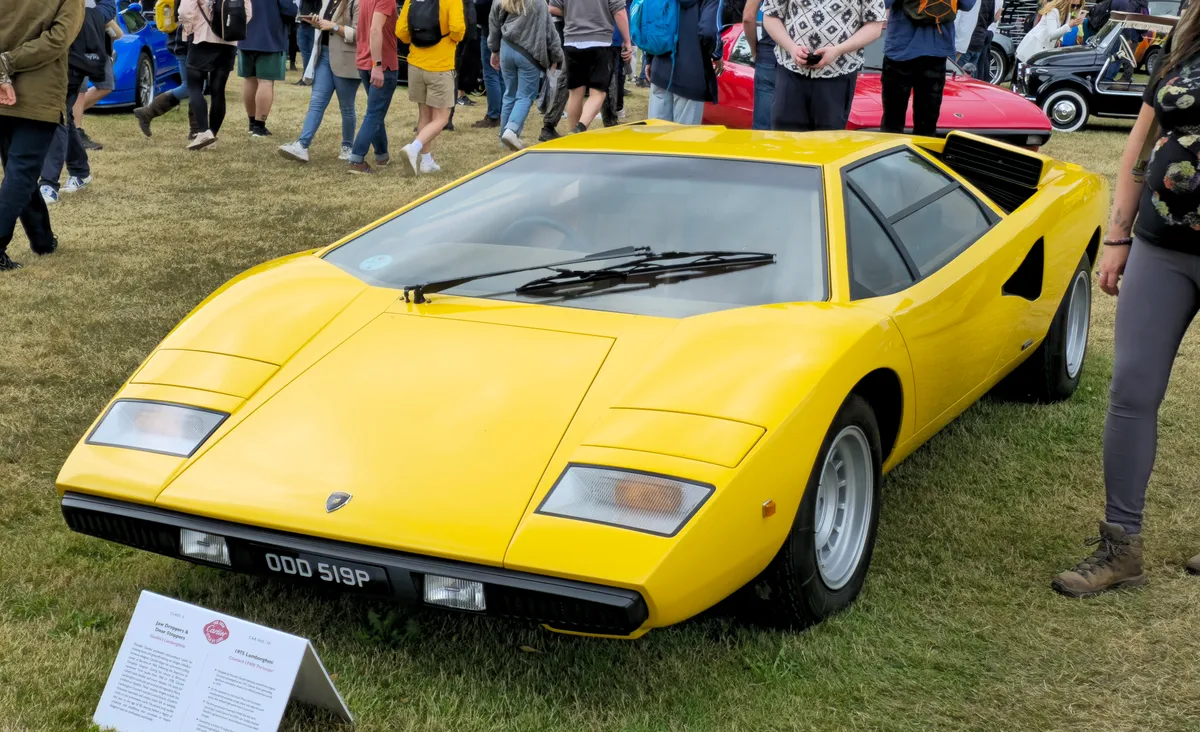
If you grew up in the '80s, you know exactly what a Countach is. Marcello Gandini's design at Bertone was so radical that even Lamborghini's own engineers wondered if it could be built. The scissor doors alone would have made it iconic.
But the whole package — the wedge profile, the NACA ducts, the massive wheel arches — created the template for what a supercar was supposed to look like. The name supposedly came from a Piedmontese exclamation of astonishment.
The evolution from the clean LP400 to the cartoonish 5000 QV (with its bolt-on fender flares) split enthusiasts. But every version was unmistakably a Countach, and that was the point.
Patina notes
Early LP400 cars are the purist choice — the cleanest lines before the add-ons. Later 5000 QV cars are more dramatic and more recognizable as 'the poster.' Both have appreciation potential, but the early cars command premiums among serious collectors.
The body panels are aluminum over a tube frame; rust isn't the concern — it's impact damage and proper panel gaps.
Ownership reality
This is not a car you casually own. The driving position is terrible — offset pedals, zero visibility, a clutch that requires leg-pressing a Buick. The transmission fights you. The cooling system was marginal when new.
But none of that matters when you fire up the V12 and the world stops to stare. A Countach demands commitment: dedicated shop relationships, significant annual budgets, and the willingness to be an event wherever you park. The owners club is tight-knit and essential.
The verdict
Buy if
You have significant capital and want the definitive '80s supercar. You have access to qualified specialists. You understand that driving a Countach is a production, not transportation.
Skip if
You expect usability. You need to fit luggage. You don't have deep specialist connections.
What to look for
- → Tube frame condition (rust and accident damage)
- → Engine-out service history
- → Clutch and transmission condition
- → Cooling system upgrades
- → Interior condition (replacement parts scarce)
- → Verification of claimed production series
Common problems
- ⚠ Overheating in traffic
- ⚠ Clutch requires significant leg strength
- ⚠ Visibility is genuinely dangerous
- ⚠ Carburetors need constant tuning
- ⚠ Interior materials degrade badly
- ⚠ Qualified mechanics are rare
Parts & community
Parts sources
- Lamborghini Polo Storico (official heritage)
- The Shop in Atlanta
- Gary Bobileff (California)
- Europe via marques specialists
Forums & communities
- LamboCARS.com
- LamboPower.com
- Countach Register
Sources
- Hagerty Valuation · 2026-02-04
- Lamborghini Polo Storico · 2026-02-04
Specifications
| Engine | 3.9L-5.2L V12 (varies by year) |
| Power | 375-455 hp (varies by year) |
| Torque | 266-369 lb-ft (varies by year) |
| Transmission | 5-speed manual (dogleg pattern) |
| Drivetrain | RWD (mid-engine, longitudinal) |
| Weight | 2,915-3,285 lbs (varies by year) |
| Wheelbase | 96.5 inches |
| Production | Approximately 2,000 total |
Notable Features
- • Scissor doors
- • Bertone wedge design by Gandini
- • Longitudinally-mounted V12
- • Massive rear fenders (5000 QV)
- • Definitive poster car
About Lamborghini
Born from a tractor magnate's grudge against Enzo Ferrari. Still building poster cars for bedroom walls.
View all Lamborghini vehicles →Find one
Looking to buy? Search current and past listings on Bring a Trailer.
Search on Bring a Trailer →