Why this vehicle matters
The 1969 Firebird is when Pontiac's pony car came into its own. While the Camaro got more aggressive styling, the Firebird went racing. The Trans Am was born this year — a homologation special named after the SCCA racing series Pontiac wanted to dominate.
Only 697 were built, all painted Cameo White with blue stripes. The Ram Air IV engine was Pontiac's masterpiece: round-port heads, radical cam timing, and performance that the factory underrated for insurance purposes.
The '69 Firebird is GM's pony car for people who wanted more than a rebadged Camaro.
Patina notes
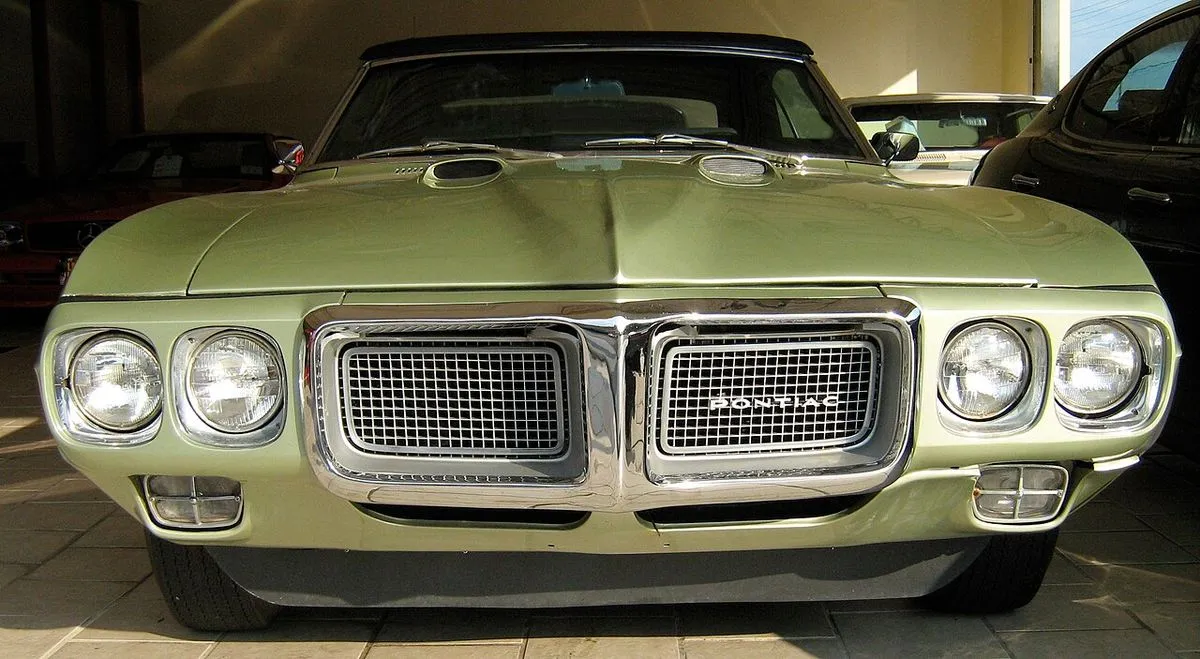
First-gen Firebirds are beautiful cars that wear age well. The split grille design is distinctive. Original Carousel Red, Warwick Blue, and Verdoro Green have the right period character.
Watch for rust in the same places as the Camaro — floor pans, trunk, and subframe. Trans Ams are so rare and valuable that fakes are common. Documentation is critical.
Regular Firebirds and Formula 400s offer similar performance at a fraction of the cost.
Ownership reality
The Firebird shares most of its parts with the Camaro, but some Pontiac-specific pieces are harder to find. The Ram Air engines have unique intakes and exhaust manifolds that are expensive to replace.
The Pontiac enthusiast community is extremely knowledgeable and welcoming. PHS documentation can verify any Pontiac built after 1960. The car is surprisingly comfortable for long distances. Power steering and air conditioning were common options.
The verdict
Buy if
You want a pony car with Pontiac character instead of Chevrolet's mass-market appeal. You appreciate the history of Trans-Am racing. You want something rarer than a Camaro but with similar parts availability.
Skip if
You need absolute maximum parts availability. You're shopping for a Trans Am on a regular Firebird budget. You don't want to explain the difference between a Firebird and a Camaro repeatedly.
What to look for
- → Subframe rust and cracks (same as Camaro)
- → Cowl and windshield pillar rot
- → Floor pan condition under carpet
- → PHS documentation for all Pontiacs
- → Ram Air cars should have correct intakes and hood
- → Trans Am verification (only 697 built)
- → Frame rail damage from improper jacking
Common problems
- ⚠ Pontiac-specific Ram Air parts are expensive
- ⚠ Drum brakes are inadequate (upgrade available)
- ⚠ Heater core access is painful
- ⚠ Power window motors fail
- ⚠ Positraction differentials wear out
- ⚠ Hood tach (if equipped) often broken
Parts & community
Parts sources
- Ames Performance Engineering
- Classic Industries
- Original Parts Group (OPGI)
- The Parts Place
- Year One
Forums & communities
- PY Online (Pontiac enthusiasts)
- First Generation Firebird
- Pro-Touring.com
- CamaroZ28.com (shared platform)
Sources
- PHS Automotive Services · 2026-02-01
- Hagerty Valuation Tools · 2026-02-01
Specifications
| Engine | 350 V8 / 400 V8 (Ram Air III/IV) |
| Power | 265-345 hp |
| Torque | 355-430 lb-ft |
| Transmission | 3-speed auto / 4-speed manual |
| Drivetrain | RWD |
| Weight | 3,400 lbs |
| Wheelbase | 108 inches |
| Production | 87,709 (1969 Firebird), 697 (1969 Trans Am) |
Notable Features
- • First year of Trans Am
- • Ram Air IV was Pontiac's ultimate engine
- • Shared platform with Camaro
- • Only 697 Trans Ams built in 1969
About Pontiac
GM's excitement division. Pontiac built cars for people who wanted more than basic transportation — they wanted to feel something.
View all Pontiac vehicles →Find one
Looking to buy? Search current and past listings on Bring a Trailer.
Search on Bring a Trailer →