Why this vehicle matters
The /5 series is where BMW motorcycles stopped being pre-war engineering with better paint and became genuinely modern machines. Everything changed: new engine cases, new frame, telescopic forks instead of the Earles leading-link setup, electric start, 12-volt electrics.
BMW took the boxer twin concept they'd been refining since 1923 and rebuilt it from the crankshaft out. The R75/5 was the sweet spot of the range — enough displacement to tour comfortably, not so much that insurance companies got nervous.
These bikes crossed continents when most motorcycles were still being ridden to the corner pub and back. The /5 created the template that BMW would follow for the next three decades: reliable, comfortable, shaft-driven, and utterly undramatic in the best possible way.
Patina notes
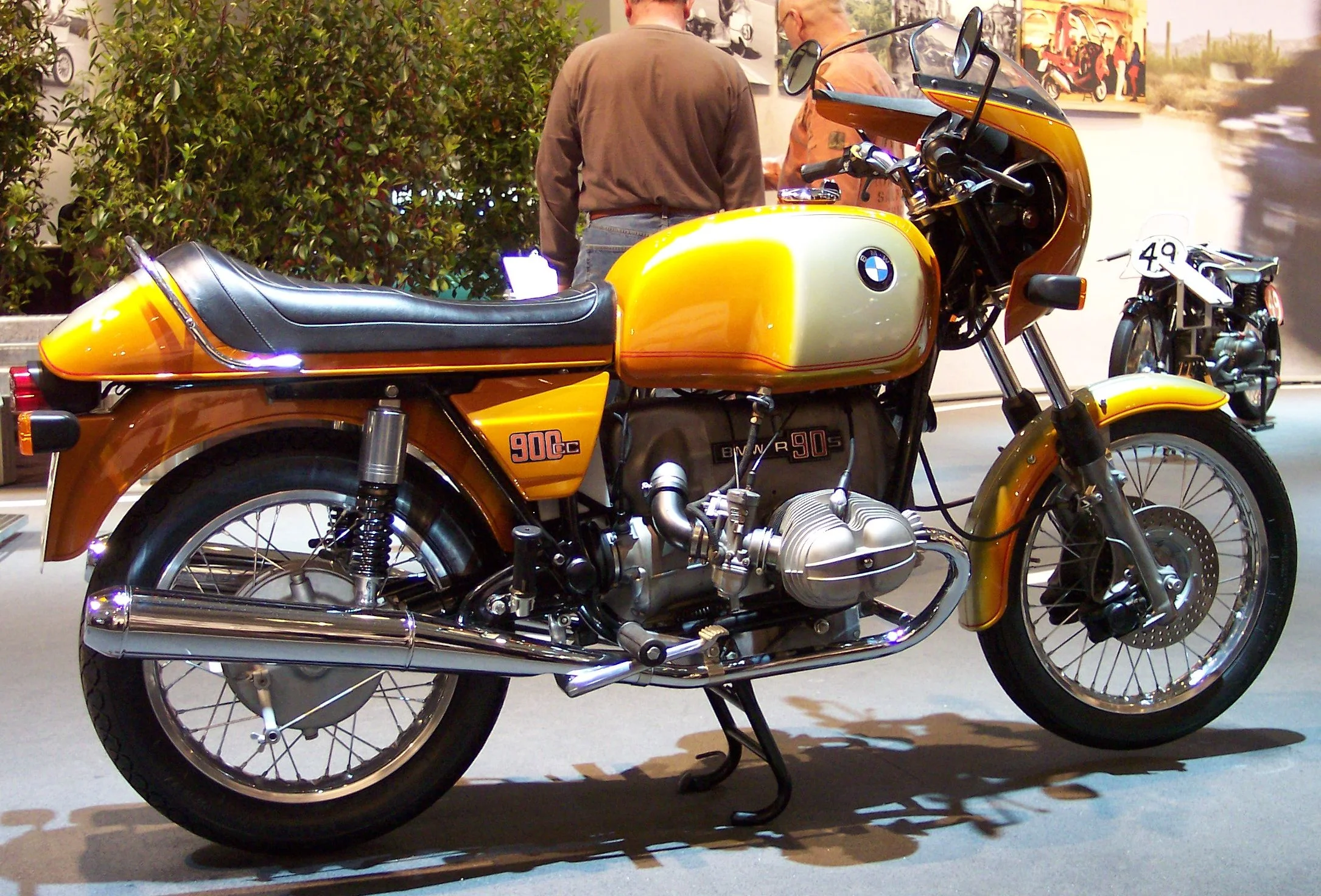
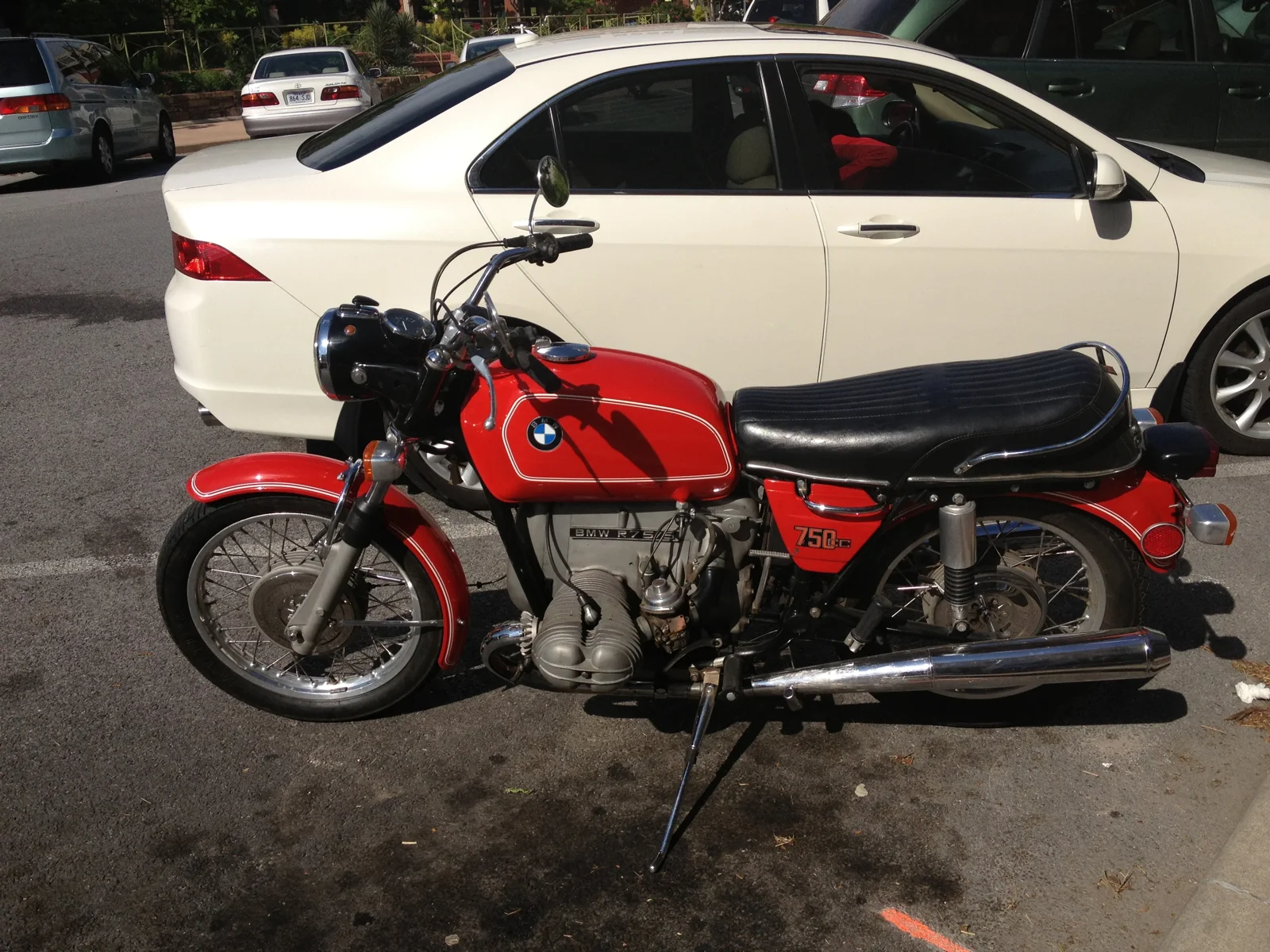
The /5 ages with the quiet dignity you'd expect from a BMW. Chrome on the exhaust headers develops a golden-brown heat patina that actually looks better than fresh plating.
The toaster-style tank (early models) or later rounded tank both wear their paint gracefully — BMW's paint quality was genuinely excellent. The engine cases oxidize to a matte silver that photographs beautifully.
Pinstriping on the tank fades and checks, which somehow adds to the bike's presence. The rubber fork gaiters crack and split — replace them or don't, but cracked gaiters on a /5 are practically a badge of honor.
The seat cover eventually cracks along the seams, and the foam underneath compresses into a perfect mold of the owner's backside over about 30,000 miles.
Ownership reality
This is the motorcycle equivalent of a well-built house — it just works, year after year, with routine maintenance that any competent home mechanic can handle. Valve adjustments are dead simple with the cylinders sticking out in the breeze.
Oil changes are straightforward. The shaft drive means no chain to adjust or replace. The /5 will cruise at 75 mph all day long without complaint, and the boxer engine's low center of gravity makes it remarkably stable at highway speed.
The downsides are period brakes (the single front drum is adequate, not inspiring) and a charging system that can struggle with modern accessories. Parts availability is excellent — BMW's aftermarket is one of the best in motorcycling.
These bikes routinely hit 100,000 miles with basic care, which is why so many are still running.
The verdict
Buy if
You want a motorcycle that rewards maintenance with absolute reliability and will take you anywhere you point it without drama. You appreciate engineering that prioritizes durability over excitement, and you understand that a motorcycle doesn't need to be fast to be deeply satisfying. The /5 is the gateway drug to BMW ownership — affordable, approachable, and backed by one of the best enthusiast communities in motorcycling.
Skip if
You need your motorcycle to make a statement. The /5 is the opposite of flashy — it's the bike equivalent of a well-tailored gray suit. Also skip if you can't live with drum brakes and want to ride aggressively in traffic. You can upgrade to a front disc, but at that point you're modifying a bike whose whole appeal is honest simplicity.
What to look for
- → Frame and engine number matching — BMW records are excellent, so verification is straightforward
- → Check the swingarm pivot for play — worn bushings create a vague feeling at speed
- → Inspect the diode board charging system — the original Bosch unit is known to fail
- → Front drum brake condition — shoes and cable should be fresh or recently serviced
- → Look for cracks at the steering head — rare but serious on hard-ridden examples
- → Transmission output shaft seal — leaking here means the final drive oil is going somewhere it shouldn't
- → Check for aftermarket handlebars or controls that suggest a crash history
Common problems
- ⚠ Diode board failure — the original charging system is the /5's weakest link, upgrade to a modern solid-state unit from Motorrad Elektrik
- ⚠ Starter motor brushes wear — symptoms are slow cranking, easy and cheap to rebuild
- ⚠ Speedometer and tachometer cable breakage — they're long runs with tight bends
- ⚠ Points and condensers need regular attention — electronic ignition conversion is popular and worthwhile
- ⚠ Petcock leaks — the original Karcoma petcocks develop seepage at the shaft seal
- ⚠ Rear main seal weeping — common on high-mileage engines, messy but not urgent
Parts & community
Parts sources
- Bob's BMW (Jessup, MD) — massive inventory, fast shipping, knows airheads cold
- Max BMW (CT/NH) — another deep BMW parts source with knowledgeable staff
- Motorrad Elektrik — the go-to for charging system upgrades and electrical components
- Euro MotoElectrics — electronic ignition kits and voltage regulators
- BMW MOA marketplace — member classifieds for NOS and used parts
Forums & communities
- ADVRider (advrider.com) — massive BMW community within the larger forum
- BMW MOA (bmwmoa.org) — BMW Motorcycle Owners of America, the mothership
- Airheads Beemer Club (airheads.org) — dedicated to air-cooled boxer twins
- The Internet BMW Riders (ibmwr.org)
Sources
- BMW Motorcycle Owners of America — /5 Series History · 2026-02-28
- Airheads Beemer Club Technical Resources · 2026-02-28
- Motorcycle Classics — BMW R75/5 Buyer's Guide · 2026-02-28
Specifications
| Engine | 745cc air-cooled OHV flat-twin (boxer) |
| Power | 50 hp @ 6,200 rpm |
| Torque | 44 lb-ft @ 5,000 rpm |
| Transmission | 4-speed constant mesh |
| Drivetrain | Shaft |
| Weight | 430 lbs |
| Wheelbase | 56.5 inches |
| Production | Approximately 38,000 units (all /5 models, 1969-1973) |
Notable Features
- • Electric start — first BMW motorcycle to offer it
- • Telescopic front fork replacing Earles fork
- • 12-volt electrical system
- • Rubber engine mounts
- • Long-travel rear shocks with 5-position preload
About BMW
The Ultimate Driving Machine before the marketing ruined it. BMW built driver-focused cars that rewarded skill and attention.
View all BMW vehicles →Find one
Looking to buy? Search current and past listings on Bring a Trailer.
Search on Bring a Trailer →