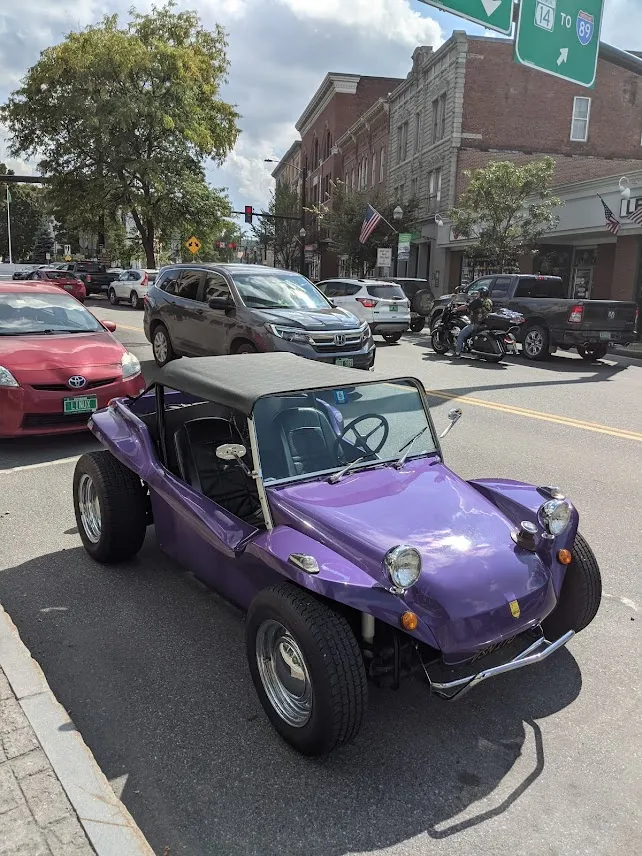
1966 Meyers Manx
1964-1971
Why this vehicle matters
The Meyers Manx answered a question nobody was asking: what if a car was designed purely for fun? Bruce Meyers, a boat builder from Newport Beach, shortened a VW Beetle pan by 14 inches, dropped a fiberglass shell on top, and created the dune buggy.
The original Old Red won the 1967 Mexican 1000 (precursor to the Baja 1000), beating motorcycles and purpose-built off-road vehicles. That race result proved the concept wasn't just a beach toy — it was legitimately capable.
The design was so simple and effective that knockoff manufacturers produced over 250,000 copies. Meyers sued, lost (the court ruled the design was too simple to protect), and watched others profit from his creation. The Manx is the Patient Zero of the kit car industry.
Patina notes
Original Meyers-built Manx buggies are rare and valuable — only about 6,000 were made. The fiberglass bodies are surprisingly durable but can crack at stress points.
Most survivors have been modified heavily; finding an original-spec Manx is difficult. Clones are everywhere, ranging from faithful reproductions to barely-related fiberglass shapes.
The VIN plate (if present) and body casting marks distinguish originals from copies. Patina on a dune buggy is expected — these were built to get dirty.
Ownership reality
The Manx is mechanically a Volkswagen Beetle, which means parts are everywhere and any air-cooled VW shop can work on it. The simplicity is the appeal: no power steering, no power brakes, no creature comforts, just a fiberglass bathtub with an engine behind you.
Modern reproduction bodies and complete kits are available if you want to build your own. Insurance and registration can be tricky depending on your state's kit car rules. These are weekend toys, not daily drivers.
The verdict
Buy if
You want the original beach-culture icon. You appreciate Bruce Meyers' contribution to automotive history. You're okay with owning a car that's essentially a fiberglass shell with a Beetle underneath.
Skip if
You need highway capability. You want weather protection. You can't wrench on air-cooled VWs.
What to look for
- → Original Meyers body vs. clone (VIN, casting marks)
- → Fiberglass cracks at mounting points
- → VW pan condition (rust, accident damage)
- → Engine and transmission condition
- → Shortened pan done correctly (not hacked)
Common problems
- ⚠ Fiberglass stress cracks
- ⚠ Rust in the VW pan
- ⚠ Incorrect shortening (DIY hacks)
- ⚠ Missing or incorrect parts
- ⚠ Clones passed off as originals
Parts & community
Parts sources
- Meyers Manx (official, still operating)
- Chirco Performance
- JBugs
- Any air-cooled VW supplier
Forums & communities
- TheSamba.com (Dune Buggy section)
- Meyers Manx Club
- Dune Buggy Archives
Sources
- Meyers Manx Official History · 2026-02-04
- Hagerty Valuation · 2026-02-04
Specifications
| Engine | VW flat-four (1200cc-1600cc, varied by donor) |
| Power | 40-60 hp (stock); 100+ hp (modified) |
| Torque | Varies by engine |
| Transmission | 4-speed manual (VW) |
| Drivetrain | RWD |
| Weight | ~1,100 lbs |
| Wheelbase | 80 inches (shortened VW) |
| Production | ~6,000 (original Meyers); 250,000+ (clones) |
Notable Features
- • Fiberglass body on shortened VW pan
- • First purpose-built dune buggy
- • Humped fenders (signature design)
- • Created entire kit car industry
- • Spawned 250,000+ imitators
About Meyers Manx
View all Meyers Manx vehicles →Find one
Looking to buy? Search current and past listings on Bring a Trailer.
Search on Bring a Trailer →