Why this vehicle matters
The Trophy is the Triumph that earned its name in the dirt before someone polished it up for the street. The TR6 lineage goes back to Triumph's 1948 ISDT team bikes, and the production version carried that competition DNA into showrooms — high-level pipes for ground clearance, a smaller tank for weight savings, and an engine tuned for midrange torque rather than top-end horsepower.
Then Steve McQueen jumped one over a fence in The Great Escape (it was actually Bud Ekins on a modified TR6, but the mythology stuck), and the Trophy became the most famous motorcycle in Hollywood history.
Beyond the movie star association, the TR6 represents something genuinely important: the moment when British manufacturers realized that Americans didn't want roadsters — they wanted machines that could handle fire roads, desert runs, and the kind of riding that would eventually become modern adventure motorcycling. The Trophy was the prototype for all of that.
Patina notes
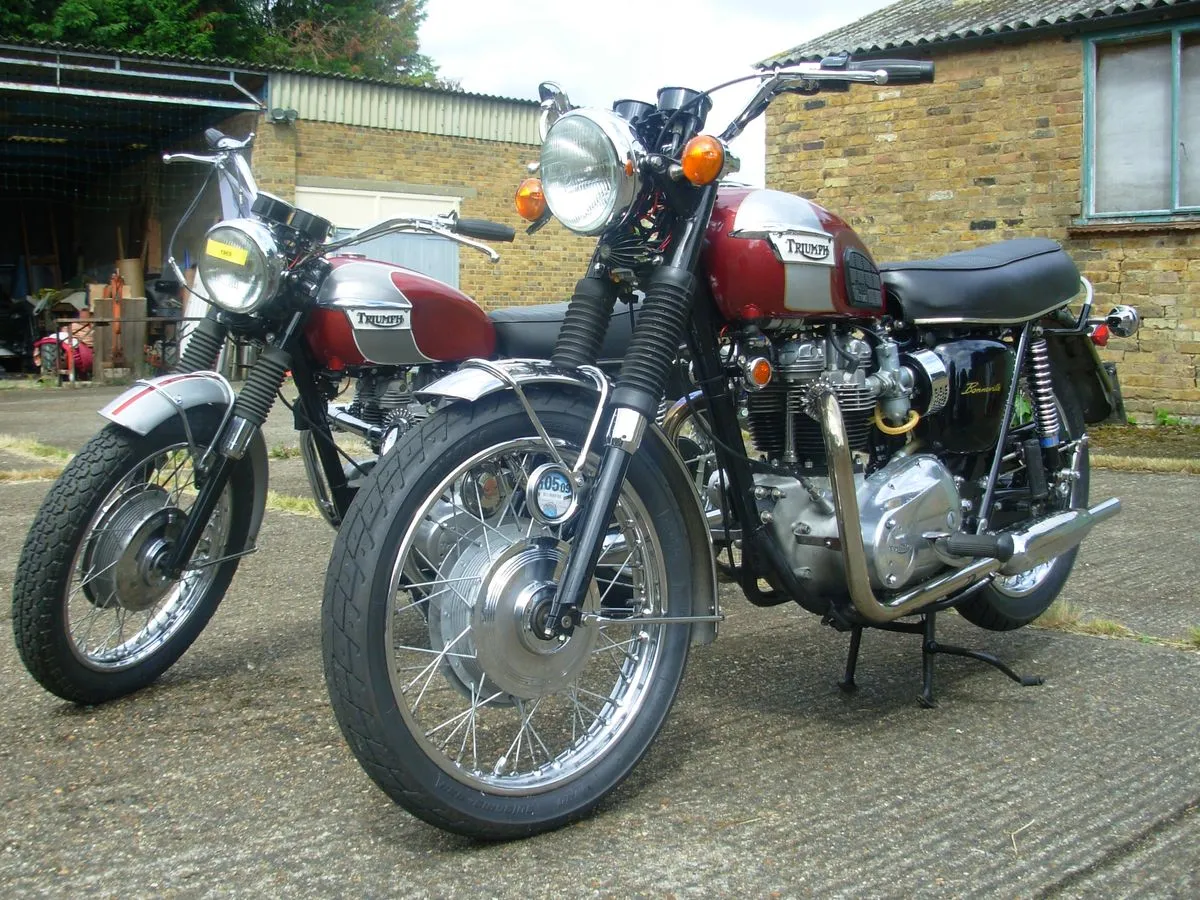
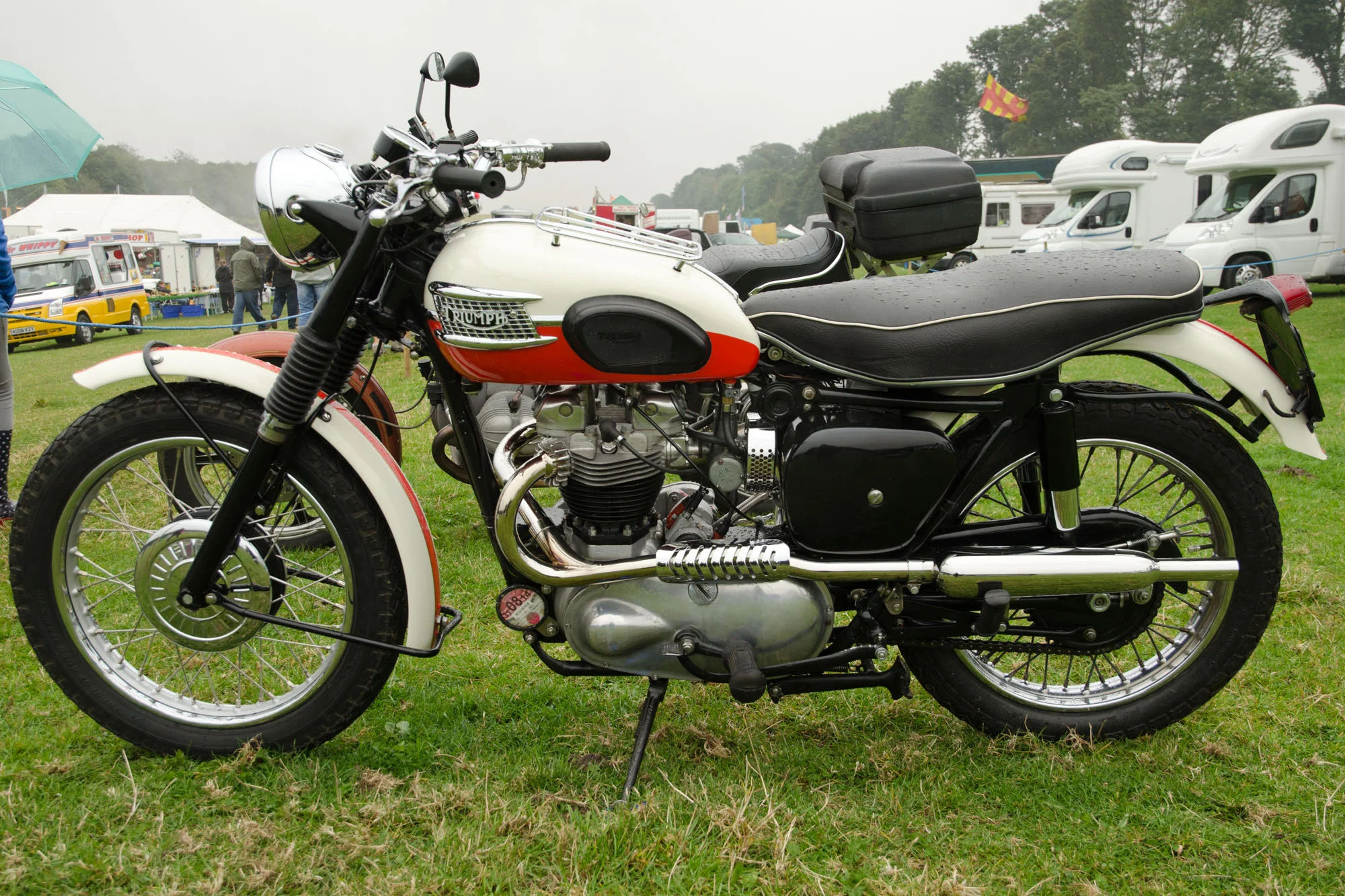
Trophies wear their age with a rugged, working-tool honesty that suits their character better than any Bonneville's showroom patina ever could. The high-level exhaust pipes discolor from chrome to bronze to blue in a heat gradient that's genuinely beautiful — don't re-chrome these unless they're structurally gone.
The smaller competition tank shows stone chips and trail rash that tell stories. Alloy mudguards on competition models develop a soft, chalky patina that's impossible to fake convincingly.
The pre-unit engine cases get the usual parallel-twin oil staining on the underside, but on a Trophy it reads as evidence of use rather than neglect.
Boot wear on the kickstart lever and gear pedal, scratches on the bash plate (if fitted), bent footpeg tips — these are merit badges. A pristine, concours Trophy has been stripped of its identity.
Ownership reality
The Trophy is arguably the most enjoyable classic British twin to actually ride, precisely because it wasn't designed to be precious. It's lighter than the Bonneville by a meaningful margin, and that weight savings transforms the handling — the Trophy steers quicker, feels more agile, and is more forgiving of rough surfaces.
The single-carb pre-unit models are dead simple to tune and maintain, though the later twin-carb unit-construction bikes (1963 onward) need proper synchronization.
The high pipes keep the exhaust out of harm's way and change the bike's center of gravity in a way that experienced riders genuinely prefer. Starting is straightforward — the 650 twin's compression ratio is civilized enough that the kick-start doesn't demand heroics.
Parts availability is excellent thanks to Triumph's enormous production numbers and a robust aftermarket. The one caveat: pre-unit construction means the engine and gearbox are separate units with a primary chain connecting them, and that primary chain needs regular attention.
The verdict
Buy if
You want a classic British twin that was built to be ridden hard rather than admired. You appreciate that the Trophy's competition heritage makes it lighter, more practical, and more interesting than the Bonneville everyone else is chasing. You want Steve McQueen's bike and you understand that the mythology is earned — the TR6 really was that good in the dirt. And you like the fact that Trophies are consistently cheaper than equivalent-year Bonnevilles despite being arguably better motorcycles.
Skip if
You want the Bonneville's twin-carb top-end rush — the Trophy's tuning priorities are different and it's softer up top. You're specifically after the pre-unit era and aren't prepared for the primary chain maintenance ritual. You need a matching-numbers, documented-history collector piece — Trophies were working bikes and many have been modified, rebuilt, and used in ways that make provenance tracking difficult. Or you're expecting The Great Escape experience — the movie bike was heavily modified with a Bonneville engine and Bud Ekins jumping it, not McQueen.
What to look for
- → Pre-unit vs. unit construction — pre-unit (1956-1962) and unit (1963-1970) are fundamentally different motorcycles
- → Engine and frame number matching — many Trophies have been rebuilt with mismatched components
- → High-pipe exhaust system condition — originals rot from inside, reproductions vary wildly in quality
- → Primary chain and tensioner condition on pre-unit models
- → Competition vs. street specification — alloy guards, quick-detach lights, smaller tank indicate competition spec
- → Crankshaft condition — listen for rumble at idle, the 650 twin's crank bearings are a known weakness
- → Frame integrity — Trophies got used hard, check for bends, cracks, and poorly repaired crash damage
- → Gearbox engagement — the pre-unit Triumph box is robust but worn selectors cause missed shifts
Common problems
- ⚠ Primary chain wear and adjustment — pre-unit design requires regular attention and correct tensioner setup
- ⚠ Oil leaks from the crankcase joint and pushrod tubes — endemic to all Triumph twins
- ⚠ Crankshaft main bearing wear — the pressed-together crank is the 650's Achilles heel
- ⚠ Amal Monobloc carburetor wear — slides develop play that affects idle and low-speed running
- ⚠ Exhaust header pipe cracking at the port — thermal stress concentrates at the flange
- ⚠ Points and condenser failure — electronic ignition conversion is the most worthwhile upgrade
- ⚠ Clutch drag in the primary chaincase — cable adjustment and friction plate condition both matter
- ⚠ Wheel spoke loosening from vibration — needs regular checking and tensioning
Parts & community
Parts sources
- Triumph parts suppliers are abundant — the aftermarket is excellent:
- Lowbrow Customs (USA) — Triumph parts and accessories
- British Cycle Supply (USA) — comprehensive Triumph catalog
- SRM Engineering (UK) — performance and restoration parts
- Tri-Supply (UK) — pre-unit Triumph specialist
- MAP Cycle (USA) — NOS and reproduction Triumph parts
- Rex Caunt Racing (UK) — electronic ignition and performance upgrades
Forums & communities
- Triumph Rat Motorcycle Forum (triumphrat.net)
- British Bike Forum (britishbikeforum.co.uk)
- Triumph Experience (triumphexp.com)
- TOMCC (Triumph Owners Motor Cycle Club)
Sources
- Triumph Trophy & Tiger Bible by Peter Henshaw · 2026-02-28
- Classic Bike Guide — TR6 Trophy Buyer's Guide · 2026-02-28
- Vintage Triumph Register — TR6 Model Reference · 2026-02-28
Specifications
| Engine | 649cc OHV air-cooled pre-unit parallel twin |
| Power | 42 hp @ 6,500 rpm |
| Torque | 37 lb-ft @ 4,500 rpm |
| Transmission | 4-speed constant-mesh |
| Drivetrain | Chain |
| Weight | 365 lbs |
| Wheelbase | 55 inches |
| Production | Approximately 25,000 units total (all TR6 variants, 1956-1970) |
Notable Features
- • High-level exhaust pipes
- • Competition-style smaller fuel tank
- • Single Amal Monobloc carburetor (early) / twin carbs (later)
- • Quickly detachable lighting
- • Alloy mudguards on competition models
- • Pre-unit engine/gearbox construction (through 1962)
About Triumph
British sports car heritage spanning cars and motorcycles. Triumph built some of the most characterful machines to ever drip oil on a garage floor.
View all Triumph vehicles →Find one
Looking to buy? Search current and past listings on Bring a Trailer.
Search on Bring a Trailer →